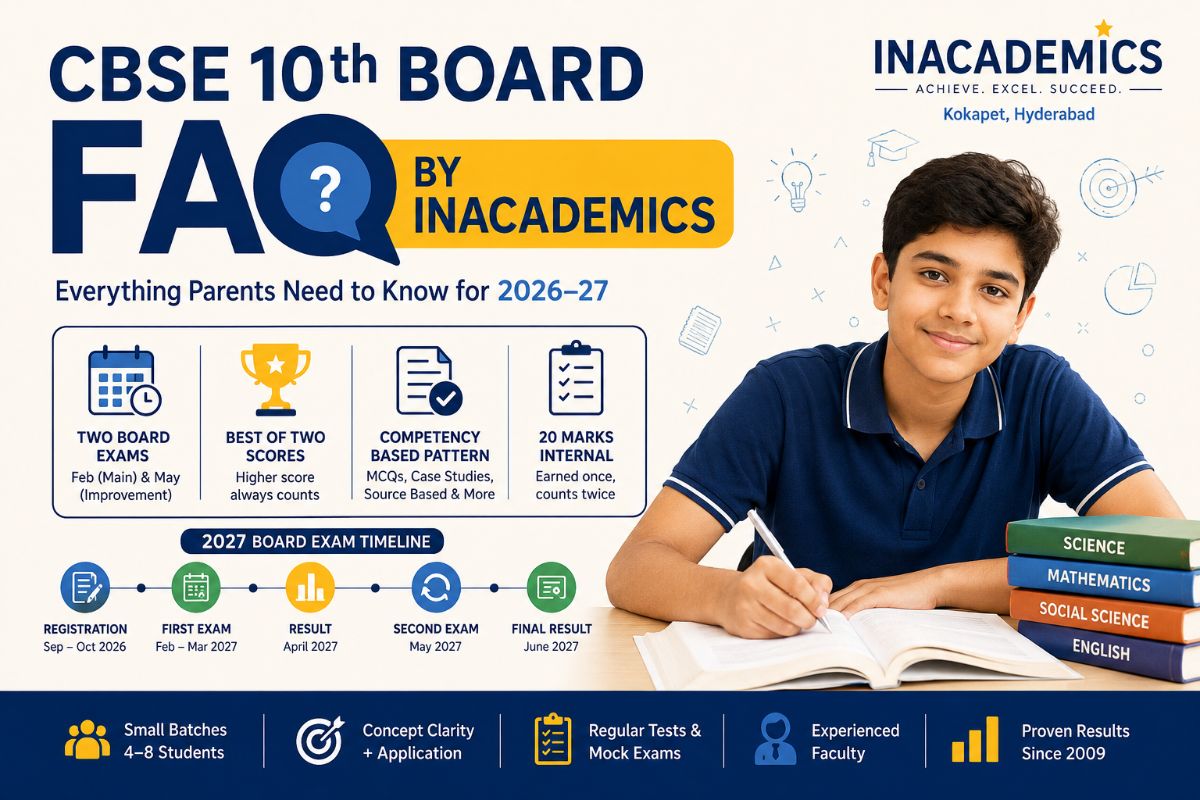
If your child entered Class 10 this academic year (2026–27), they will appear for a board exam that works very differently from the one you remember — and different even from what their seniors two years ago faced. CBSE now conducts two board exams a year for Class 10, question papers have shifted heavily towards competency-based questions, and a best-of-two scoring rule now applies.
The 2026 batch was the first to go through this system. The 2027 batch — your child's batch — is the second, which means the rules are now settled and the patterns are clear. This FAQ answers the questions parents ask us most often at our Kokapet centre, in plain language.
The Two-Exam System
Will CBSE really conduct two board exams for Class 10 in 2027?
Yes. In line with the National Education Policy (NEP) 2020, CBSE conducts the Class 10 board exam in two phases. The first exam (February–March 2027) is compulsory for every student. The second exam (expected May 2027) is optional — it exists for students who want to improve their marks or who need to clear a compartment. Class 12 continues to have a single board exam.
What is the expected timeline for the 2027 exams?
MilestoneExpected timingLOC registration through schoolSeptember–October 2026Official datesheet releasedOctober–November 2026Practical exams / internal assessmentJanuary 2027 (Nov–Dec 2026 for winter-bound schools)First (main) board examMid-February to early March 2027First exam resultApril 2027Registration for second exam10–15 day window immediately after the first resultSecond (optional) board examMay 2027Second exam result + final consolidated marksheetJune 2027
CBSE begins board exams from the first Tuesday after 15 February, so for 2027 expect the first papers around 16 February 2027, subject to the official datesheet.
Is the second exam compulsory? Should my child plan for it?
No, it is completely optional — and most students should treat February as the real exam. In the 2026 cycle, CBSE estimated only around 40% of students would appear in any given subject in the second phase. Think of May as a safety net, not a second syllabus cycle. Students satisfied with their February result simply move on to Class 11.
How does "best of two" scoring work?
The higher score always wins. If a student appears in a subject in both February and May, CBSE automatically records the better of the two scores in the final marksheet. Your child cannot lose marks by attempting the second exam — a lower May score is simply ignored. This removes the risk from an improvement attempt, though the effort of staying exam-ready until May is real.
Who is allowed to take the second exam?
Three categories:
Category Second exam rules Passed the first exam Can improve in up to three subjects from Science, Mathematics, Social Science and languages Compartment in 1–2 subjectsCan reappear in those subjects in May itself — no year lostFailed / absent in 3 or more subjectsClassified as "Essential Repeat" — must wait for the next February main exam
Two important restrictions: a student cannot skip February and appear only in May, and no new subjects can be added between the two exams. Special provisions exist for sports students, winter-bound schools and CWSN candidates.
Are practicals and internal assessment also conducted twice?
No — only once. The 20-mark internal assessment (periodic tests, multiple assessments, portfolio) and practicals are held a single time, and those marks carry into both results. Only the 80-mark theory paper can be re-attempted in May. This is worth emphasising to your child: school tests and projects now permanently lock in a quarter of the subject score.
Exam Pattern, Syllabus and Passing Rules
What is the question paper pattern for 2027?
Theory papers are for 80 marks, with 20 marks internal assessment (10 periodic tests + 5 multiple assessments + 5 portfolio). The big shift is inside the paper itself: in subjects like Science and Social Science, the paper is split into two halves — Section A (~50%) is fully MCQ and competency-based (case studies, source-based and assertion-reasoning questions), while Section B (~50%) is traditional subjective writing.
What this means practically: a child who has memorised the NCERT but cannot apply concepts to an unfamiliar scenario will struggle in Section A. Regular practice with competency-style questions is no longer optional.
Is the syllabus the same for both exams?
Yes — identical. Both the February and May papers cover the full CBSE 2026–27 syllabus, and both are set from the same sample-paper design, so CBSE maintains a similar difficulty level across the two. The May exam is not a shorter or easier paper.
What are the passing marks?
33% in each subject, counting theory and internal assessment together. Fail in one or two subjects → compartment, clearable in May. Fail in three or more → Essential Repeat, meaning reappearance only next February. NCERT textbooks remain the primary source for the papers, supplemented by CBSE's official sample papers released each year.
Basic Maths or Standard Maths — which should we choose?
Choose Standard if there is any chance your child will take Mathematics in Class 11 — it is required for Science-with-Maths and strongly recommended for Commerce-with-Maths. Basic is a gentler paper, but it generally closes the door on Class 11 Mathematics. Our advice at INACADEMICS: if the hesitation is about difficulty rather than genuine disinterest, keep Standard and fix the foundations early — that is a coaching problem, not a capability problem.
Results and Class 11 Admission
Will Class 11 admissions wait for the second exam result?
No — and your child will not be stuck. Students who pass the February exam receive a provisional marksheet (available on DigiLocker) and can take regular Class 11 admission immediately. Schools have been directed not to deny admission merely because the final consolidated certificate arrives only in June. Students with a compartment can be given provisional admission, confirmed once they clear the May exam.
When does the final marksheet arrive?
The final consolidated marksheet and passing certificate — reflecting the best score in each subject across both attempts — is generated after the May exam results, expected by end of June 2027. Re-evaluation, verification and photocopy of answer books also open only after the second exam result.
How is registration done, and what does it cost?
Registration is done only through the school via the List of Candidates (LOC) — parents cannot apply directly. For the previous cycle, the fee was around ₹1,500 for five subjects. If your child opts for the May exam, a separate registration (in the short window after the April result) and a separate fee apply.
Planning the Year: A Parent's Roadmap
When should serious preparation start?
It already should have. With boards in mid-February, the working year is short:
PeriodFocusJuly – October 2026Complete the syllabus chapter-by-chapter alongside school; build competency-question practice into every topicNovember – December 2026Finish the full syllabus; first full revision; begin previous year questions and CBSE sample papersJanuary 2027Practicals + timed full-length mock papers under exam conditions; error analysisFebruary 2027Light revision, formula sheets, sleep and confidence — no new material
How is preparing for this pattern different from the old one?
Three habits matter more than before. First, application over recall — half the paper now presents unfamiliar cases and data. Second, MCQ discipline — eliminating options, managing time, avoiding careless slips, since objective questions have no partial marks. Third, consistent internal assessment performance — those 20 marks are earned across the year and can never be improved later.
The one mistake we see most often: families treating the May exam as a built-in "second chance" and letting February preparation drift. The second exam covers the same full syllabus, comes after Class 11 has effectively begun, and momentum is hard to rebuild. Prepare to finish it in February; keep May in reserve.
Does my child need tuition for Class 10 boards?
Honestly — not every child does. A self-driven student with a strong school and disciplined revision can do well. Coaching adds the most value when a child needs structured pacing to finish the syllabus by December, regular exposure to competency-style and sample-paper questions, and individual attention on weak chapters — which is difficult in a class of 40 but exactly what small batches are built for.
How INACADEMICS Prepares Students for the 2027 Boards
At our Kokapet centre, CBSE Class 10 students learn in small batches of 4–8, with a schedule reverse-planned from the February 2027 exam: syllabus completion by December, followed by a full mock-exam cycle in January using CBSE sample-paper patterns — including dedicated Section A (MCQ/competency) drills. We have been coaching board-exam batches in Hyderabad since 2009.
Seats per batch are limited by design. If you'd like a free assessment of where your child stands today, get in touch.