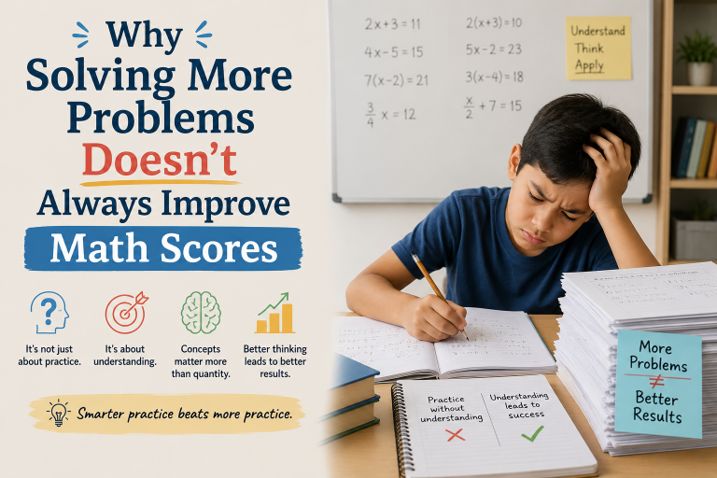
Many students believe that the secret to improving in Mathematics is simple: solve more questions. It seems logical that the greater the number of problems completed, the higher the marks should be.
Yet, many students spend hours practising only to see little improvement in their scores. The difference often isn't the quantity of practice—it's the quality of thinking that happens during it.
Why Solving More Problems Doesn't Always Improve Math Scores
Practice is an essential part of learning Mathematics. However, practice alone does not guarantee progress.
Many students become focused on completing worksheet after worksheet, believing that repetition automatically leads to mastery. While repetition can improve familiarity, it cannot replace understanding.
Across CBSE, ICSE, ISC, Cambridge IGCSE, and IB, Mathematics assessments increasingly reward logical reasoning, application, and problem-solving rather than simply recognising familiar question patterns.
The Difference Between Practice and Purposeful Practice
Not all practice produces the same results.
Some students solve dozens of similar questions without stopping to understand why a particular method works. As a result, they become comfortable with routine problems but struggle when the numbers, wording, or context change.
Purposeful practice is different.
It encourages students to analyse mistakes, understand underlying concepts, and recognise patterns that can be applied to unfamiliar questions.
This type of learning creates deeper mathematical understanding rather than short-term familiarity.
Memorising Methods Has Its Limits
A common misconception is that remembering enough formulas and procedures is enough to succeed.
While formulas are important, Mathematics is ultimately about knowing when and why to use them.
Students who rely only on memorised steps often become uncertain when an examination question looks different from what they have practised.
Those with stronger conceptual understanding are more likely to adapt their knowledge and solve unfamiliar problems with confidence.
Mistakes Are Valuable Learning Opportunities
Many students check whether an answer is right or wrong and immediately move on to the next question.
However, the greatest improvement often comes from understanding why a mistake happened.
Was it a calculation error?
A misunderstanding of the concept?
Or was the question interpreted incorrectly?
Reflecting on mistakes helps students identify recurring patterns and prevents the same errors from appearing repeatedly in future assessments.
Modern Math Assessments Reward Thinking
Across CBSE, ICSE, ISC, Cambridge IGCSE, and IB, examination questions are becoming increasingly application-based.
Students are expected to connect concepts, interpret information, and justify their reasoning rather than simply reproduce memorised procedures.
This is why students sometimes feel surprised by examination questions that appear different from those in their textbooks.
The mathematics itself has not changed—but the expectation to think independently has.
What Successful Students Do Differently
High-performing students certainly practise regularly, but they also reflect on their learning.
Instead of asking, "How many questions did I finish?", they ask:
Why did this method work?
Could I solve this another way?
What mistake am I likely to repeat?
This mindset transforms practice from a routine task into a process of continuous improvement.
Conclusion
Improving in Mathematics is not about solving the greatest number of questions—it is about understanding the ideas behind them.
When students combine regular practice with conceptual understanding, reflection, and analytical thinking, they become better equipped to handle unfamiliar challenges.
Across CBSE, ICSE, ISC, Cambridge IGCSE, and IB, lasting success in Mathematics comes not from practising more, but from practising with greater purpose.
KEY TAKEAWAYS
More practice does not always lead to better Math scores.
Conceptual understanding is more valuable than memorising methods.
Analysing mistakes helps prevent repeated errors.
Modern Mathematics assessments reward reasoning and application.
Purposeful practice builds confidence and long-term problem-solving skills.
FINAL REFLECTION
At Inacademics, we believe meaningful progress in Mathematics comes from understanding concepts, not simply completing more questions. Through personalised guidance and curriculum-specific expertise across CBSE, ICSE, ISC, Cambridge IGCSE, and IB, we help students develop stronger reasoning, deeper confidence, and lasting mathematical thinking.