Many students approach IB DP Physics by jumping straight into past-paper questions. While practice is important, it often leads to frustration when the underlying concept is not fully understood.
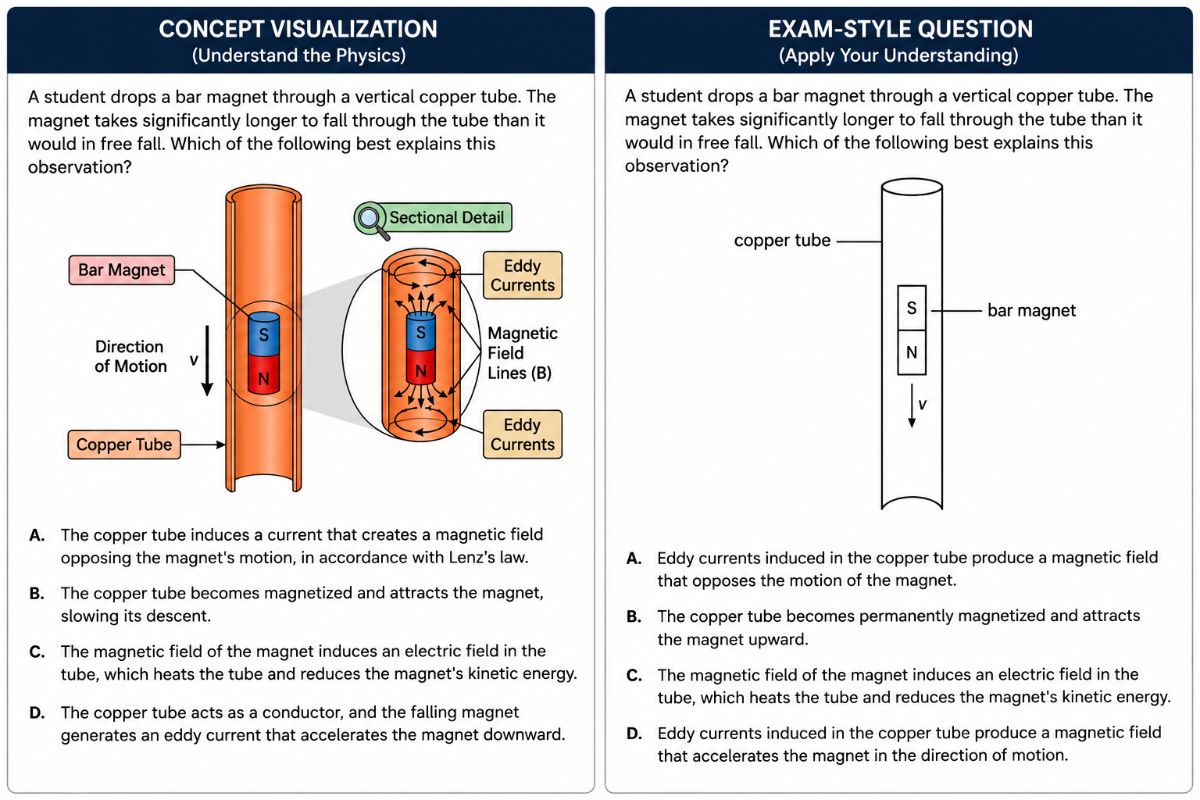
Consider the classic example of a bar magnet falling through a copper tube.
A student may memorize that the answer involves "eddy currents" or "Lenz's law," but without visualizing what is actually happening, the concept remains abstract. When the same idea appears in a different context during an examination, students struggle to apply their knowledge.
The Traditional Approach
Most resources present students directly with an examination-style question:
Read the question.
Recall a formula.
Choose an answer.
Move to the next question.
This approach can work for straightforward calculations, but it often fails when questions test conceptual understanding.
Our Approach
At INACADEMICS, we believe students should first see the physics before solving the physics.
Our concept visuals are designed to help students understand:
What is changing in the system.
Why induction occurs.
How magnetic fields interact.
Why energy is transferred.
How Lenz's law explains the observed behaviour.
Instead of memorizing an answer, students develop a mental model of the phenomenon.
When students see the magnet falling through the copper tube, they can visualize:
The changing magnetic flux.
The induced eddy currents.
The opposing magnetic field.
The resulting magnetic braking force.
Once this understanding is established, the examination question becomes significantly easier.
From Concept to Examination
After studying the visual explanation, students can transition to a simplified IB-style examination diagram.
At this stage, the colourful explanatory labels are removed.
Students must now rely on their understanding rather than hints provided by the diagram.
This mirrors the actual IB examination environment.
The result is a much deeper level of learning.
Why This Matters in IB DP Physics
Many of the most challenging topics in DP Physics require conceptual understanding before mathematical application.
Examples include:
Electromagnetic induction
Quantum physics
Wave interference
Electric fields
Magnetic fields
Nuclear physics
Students who understand the underlying physics often find that calculations become straightforward.
Students who rely only on memorization often struggle when questions are presented in unfamiliar ways.
Learn. Visualize. Apply.
The goal is not simply to answer one question correctly.
The goal is to understand the physics so thoroughly that you can solve any variation of the question that appears in an examination.
That is why INACADEMICS follows a simple philosophy:
Understand the concept visually → Apply the physics → Solve the exam question.
When students build conceptual understanding first, examination success becomes a natural outcome rather than a guessing game.
INACADEMICS – Learn the Concept. Master the Exam.