One of the most valuable lessons students learn in IB MYP Physics is that science is not simply about collecting observations. Scientists must interpret evidence, evaluate methods, and decide whether observations truly support or challenge a scientific model.
A seemingly simple experiment involving iron filings and a bar magnet provides an excellent example of this scientific thinking process.
The Investigation
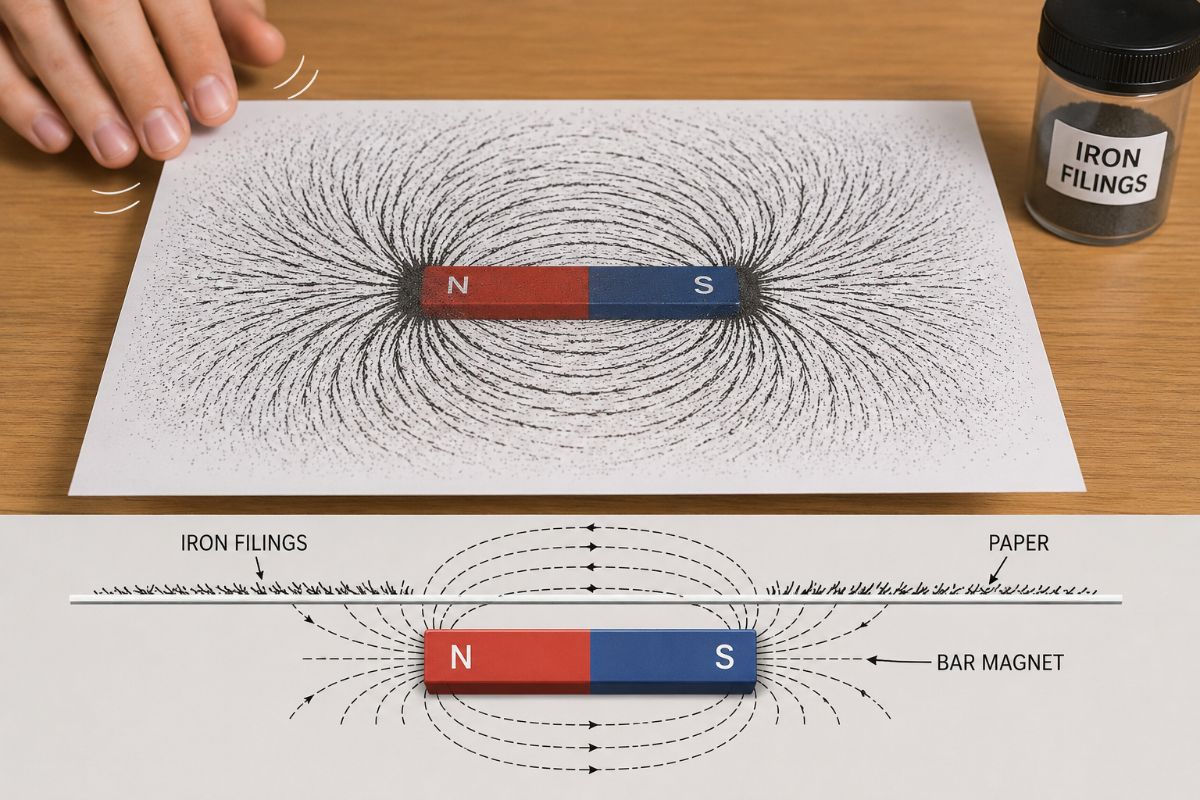
A student places a bar magnet beneath a sheet of paper and sprinkles iron filings across the surface. After gently tapping the paper, the filings align themselves according to the magnetic field around the magnet.
The resulting pattern appears mostly as expected. Curved lines extend from the north pole to the south pole, illustrating the magnetic field surrounding the magnet.
However, the student notices something unusual.
Near the north pole, a cluster of iron filings appears to form a curved path that bends back toward the same pole. At first glance, this suggests that a magnetic field line begins and ends at the north pole.
The student wonders whether this observation challenges the accepted model of magnetic field lines.
Understanding Scientific Models
Before answering this question, it is important to understand what magnetic field lines actually represent.
Magnetic field lines are not physical objects that exist in space. Instead, they are a scientific model used to visualize the direction and strength of a magnetic field.
According to the accepted model:
Magnetic field lines emerge from the north pole and enter the south pole outside the magnet.
Inside the magnet, they return from south to north.
Together they form continuous closed loops.
This model has been supported by countless experiments and observations over many years.
Does the Observation Challenge the Model?
The short answer is no.
The observation does not indicate that magnetic field lines begin and end at the same pole.
Instead, it highlights a limitation of the experimental technique.
Iron filings align with the local magnetic field at individual points. They do not trace complete field lines. Near the poles, where the magnetic field is strongest, the filings often become densely packed together.
As a result:
Individual filings can overlap.
Small clusters may appear disconnected.
Curved patterns can create misleading visual impressions.
The overall field structure may be difficult to interpret accurately.
What the student observes is therefore a limitation of the visual representation rather than evidence against the scientific model.
Why the Model Remains Valid
Scientific models are not rejected because of a single unusual observation.
Instead, scientists ask:
Can the observation be explained by experimental limitations?
Is the observation reproducible?
Does it agree with other evidence?
Does the model continue to explain a wide range of phenomena?
The magnetic field model remains valid because:
It successfully predicts magnetic behaviour.
It explains the operation of motors and generators.
It is supported by multiple experimental methods.
No isolated magnetic poles (magnetic monopoles) have been observed.
Therefore, the student's observation does not invalidate the model.
Rather, it demonstrates the importance of interpreting experimental evidence carefully.
Developing Higher-Order Thinking in MYP Physics
Many traditional science questions focus on recalling facts and formulas.
This question goes much further.
Students are required to:
Interpret evidence.
Evaluate an experimental method.
Identify limitations of a model.
Construct a scientific argument.
Justify a conclusion using evidence.
These skills represent the transition from simply learning science to thinking like a scientist.
Connections to MYP Assessment Criteria
Criterion A: Knowing and Understanding
Students demonstrate understanding of:
Magnetic fields
Magnetic poles
Field line models
Criterion C: Processing and Evaluating
Students analyse observations and evaluate the reliability of evidence.
Criterion D: Reflecting on the Impacts of Science
Students consider how scientific models are developed, tested, refined, and used to explain natural phenomena.
This makes the question an excellent example of the type of analytical thinking expected in MYP 4 and MYP 5.
The Bigger Scientific Lesson
One of the most important habits scientists develop is skepticism.
Scientists do not automatically accept every observation at face value.
Instead, they ask:
Could the method have introduced errors?
Are there alternative explanations?
Does the evidence truly challenge the model?
This mindset is at the heart of scientific inquiry and is one of the key goals of IB MYP Physics.
How INACADEMICS Helps Students Master MYP Physics
At INACADEMICS, we believe that success in Physics comes from understanding concepts, not memorising answers.
Our MYP Physics programmes help students:
Build strong conceptual foundations.
Understand scientific models and their limitations.
Develop Criterion A, C, and D skills.
Analyse unfamiliar situations confidently.
Prepare for the transition from MYP 5 to IB Diploma Physics.
Questions like this magnetic field investigation teach students how scientists think, evaluate evidence, and justify conclusions—skills that lead to long-term success not only in Physics but across all scientific disciplines.
Because in IB Physics, the goal is not simply to know the answer. The goal is to understand why the answer is correct.