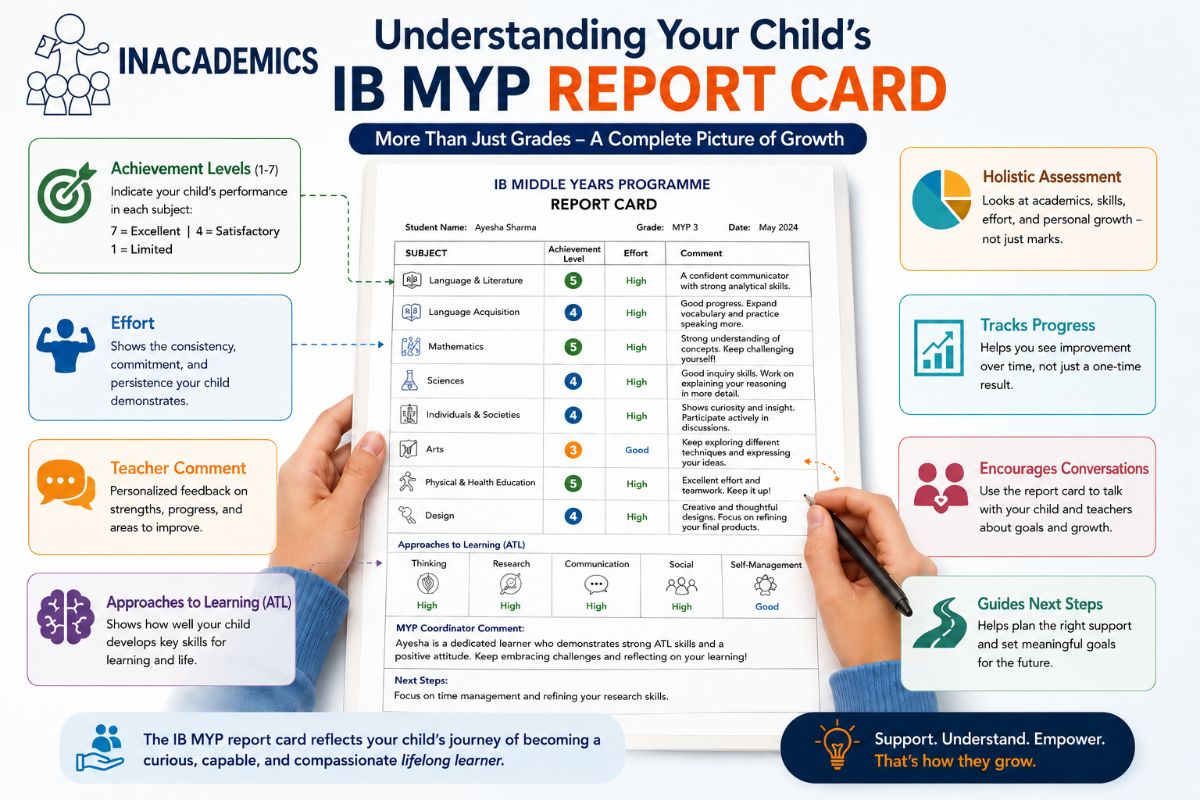
The first time most Hyderabad parents see an IB MYP report card, the reaction is the same: confusion. There are no percentages. No rank. No 'Pass' or 'Fail'. Instead there are letters — A, B, C, D — and numbers from 1 to 7. What does it all mean, and is your child actually doing well?
This guide decodes every element of the MYP report card so you can have a real conversation with your child about where they stand — and what to do next.
The Four MYP Criteria — A, B, C, D
Every MYP subject is assessed on four criteria. The exact criteria differ by subject group, but the underlying logic is the same:
• Criterion A — Knowing and Understanding: Can the student recall and apply subject content accurately?
• Criterion B — Investigating / Inquiring and Designing: Can the student design experiments, formulate questions, or plan inquiries?
• Criterion C — Processing and Evaluating / Communicating: Can the student analyse data, draw conclusions, and present work clearly?
• Criterion D — Reflecting on the Impacts / Real-World Application: Can the student connect learning to the real world, ethical implications, and personal reflection?
In Mathematics, these four criteria have slightly different names (Knowing and Understanding, Investigating Patterns, Communicating, Applying Mathematics in Real-life Contexts), but the structure is the same.
What the Numbers Mean — The 1 to 8 Scale
Each criterion is marked out of 8, using descriptors in the MYP subject guide. Here is a rough translation for parents:
• 1–2: The student has not yet demonstrated understanding of this criterion. Significant gaps exist.
• 3–4: The student has partial understanding. They can do some tasks but make consistent errors or miss depth.
• 5–6: The student demonstrates solid understanding with minor gaps. This is a good, functional level.
• 7–8: The student demonstrates thorough, nuanced understanding with strong application. This is excellence.
The key insight: a 4 in Criterion A is not the same as 50%. The number reflects a level descriptor — it tells you what your child can and cannot do, not how many marks they got out of how many.
The Final Grade — 1 to 7
After all four criteria are marked, the school converts the combined raw score to a final MYP grade between 1 and 7. The IB publishes grade boundaries, but schools may also set internal boundaries.
• Grade 7 (Excellent) — Typically requires 27–32 out of 32 across all four criteria combined
• Grade 6 (Very Good) — Typically 23–26 out of 32
• Grade 5 (Good) — Typically 18–22 out of 32
• Grade 4 (Satisfactory) — Typically 14–17 out of 32
• Grade 3 (Mediocre) and below — Indicates serious gaps that need immediate attention
A Grade 5 is a passing, solid grade. A Grade 4 is acceptable but indicates room for improvement. Grades 1–3 require intervention.
What 'ATL' and 'Approaches to Learning' Mean
Many MYP report cards include an ATL (Approaches to Learning) section with descriptors like 'Emerging', 'Developing', 'Using', or 'Extending'. These are not academic grades — they assess skills like organisation, communication, collaboration, and self-management. Think of them as a teacher's assessment of your child's learning habits, not their academic knowledge.
Don't dismiss the ATL section. A child marked 'Emerging' in Self-Management is being flagged for poor organisation or time management — an early warning sign worth addressing.
How to Use the Report Card as a Parent
1. Identify which criterion is lowest — that is where the most value is for targeted revision.
2. Compare across subjects: is Criterion D (real-world connection) consistently low? That suggests a conceptual habit to fix, not just a subject problem.
3. Don't compare to other students. The MYP is not norm-referenced (ranked against peers). Compare only to the grade descriptors.
4. Talk to the teacher or tutor about what a higher criterion score would look like in practice — ask for a sample answer.
A Note on School-Specific Differences
Different IB schools in Hyderabad — Oakridge, TISH, Chirec, Indus, and others — may present report cards slightly differently. Some give criterion scores; others only give the final 1–7 grade. If you only see the final grade, ask the school for criterion-level feedback — every IB school should be assessing all four criteria.
Ready to give your child the right guidance? INACADEMICS in Kokapet, Hyderabad has been helping IB MYP, IGCSE, ICSE, and CBSE students achieve their best since 2009. Small batches, certified teachers, and a proven track record — book a free counselling session today.
INACADEMICS · Kokapet, Hyderabad · inacademics.com