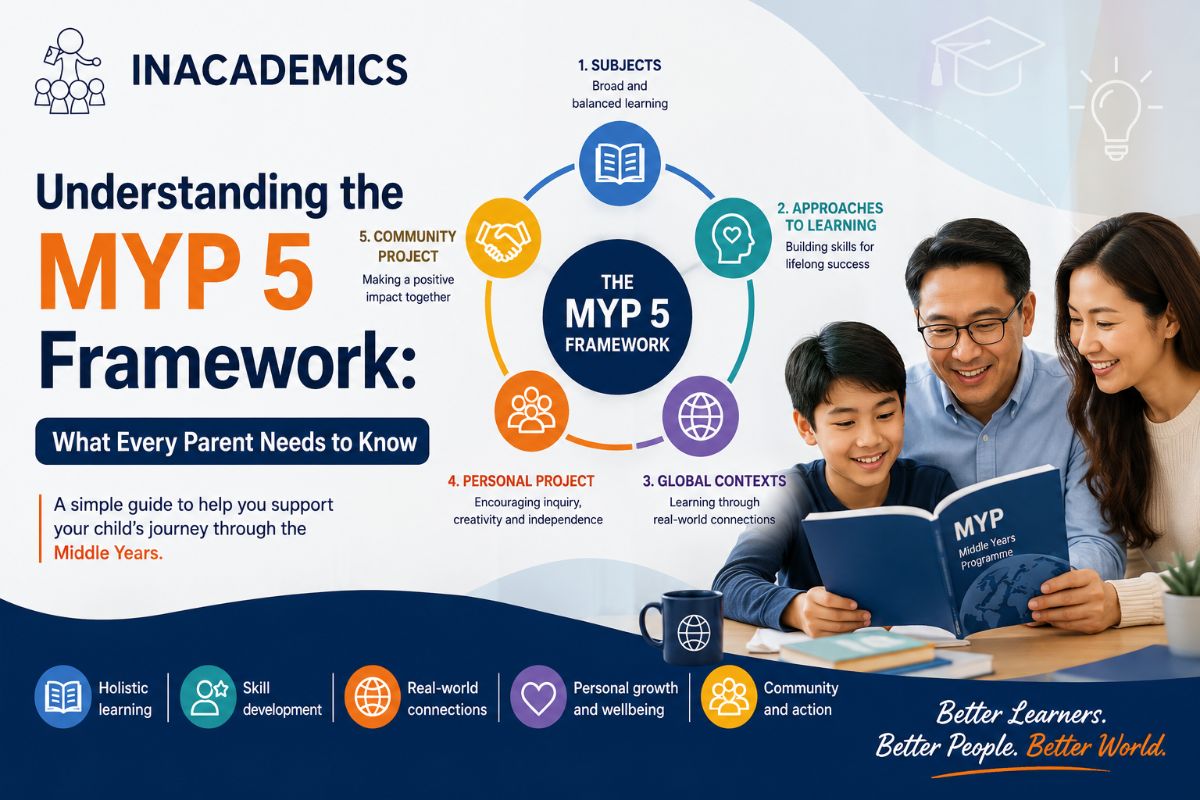
What Is the IB Middle Years Programme (MYP)?
The International Baccalaureate Middle Years Programme (MYP) is a globally recognized educational framework designed for students aged 11 to 16. MYP 5, the final year of this programme, is particularly critical as it serves as the gateway to the IB Diploma Programme (DP) and determines academic trajectories for many students. Understanding this framework is the first and most important step for any parent who wants to support their child effectively.
Unlike traditional examination systems, the MYP is built on the philosophy of developing the whole student — academically, socially, and personally. It encompasses eight subject groups: Language and Literature, Language Acquisition, Individuals and Societies, Sciences, Mathematics, Arts, Physical and Health Education, and Design. In MYP 5, students are expected to demonstrate mastery across all eight subject groups while simultaneously completing their Personal Project.
Assessment in MYP 5
MYP 5 assessments differ significantly from traditional national curricula. Each subject is assessed using criteria-based rubrics, typically on a scale of 0–8. The criteria vary by subject but always align with the four universal MYP assessment objectives: Knowing and Understanding, Applying Skills, Thinking Critically, and Communicating. Parents need to familiarise themselves with these criteria early on, as understanding what is expected helps guide revision and preparation.
Some schools participate in the eAssessment programme, which means students sit on-screen examinations for certain subjects. These exams are externally marked by the IB, providing an internationally benchmarked qualification. Whether or not your school offers eAssessment, the criteria-based assessment approach remains consistent.
The Personal Project: A Cornerstone of MYP 5
One of the most distinctive elements of MYP 5 is the Personal Project. This independent, student-directed project requires learners to explore a topic of personal interest, produce an outcome, and reflect critically on the process. It is assessed on criteria including Goal, Planning, Taking Action, and Reflecting. Parents play a vital but non-directive supporting role: encourage, listen, but let the student lead. This project can be deeply rewarding if students embrace it as a genuine inquiry rather than a checkbox exercise.
💡 Parent Action: Download the MYP Subject Guides from the IB's public website (ibo.org) and spend 30 minutes reviewing the assessment criteria for your child's key subjects. This single act will transform how you understand their progress.
Learner Profile and ATL Skills
The IB MYP is underpinned by the Learner Profile — ten attributes that describe the kind of person the IB aims to develop: Inquirer, Knowledgeable, Thinker, Communicator, Principled, Open-minded, Caring, Risk-taker, Balanced, and Reflective. Alongside the Learner Profile, Approaches to Learning (ATL) skills — covering Communication, Social, Self-Management, Research, and Thinking skills — are embedded throughout the curriculum. Encourage your child to reflect on these attributes not just in academics but in daily life.
Key Dates and Milestones
Every MYP 5 year has critical milestones. These typically include: Personal Project proposal submission (often in Term 1), mid-year assessments, Personal Project completion deadline (often late Term 2), and final criterion-based assessments across all subjects (Term 2 or Term 3). Work with your child to map out these dates at the start of the year and build a family-level awareness of when pressure points will arise.
Celebrate effort regardless of outcome