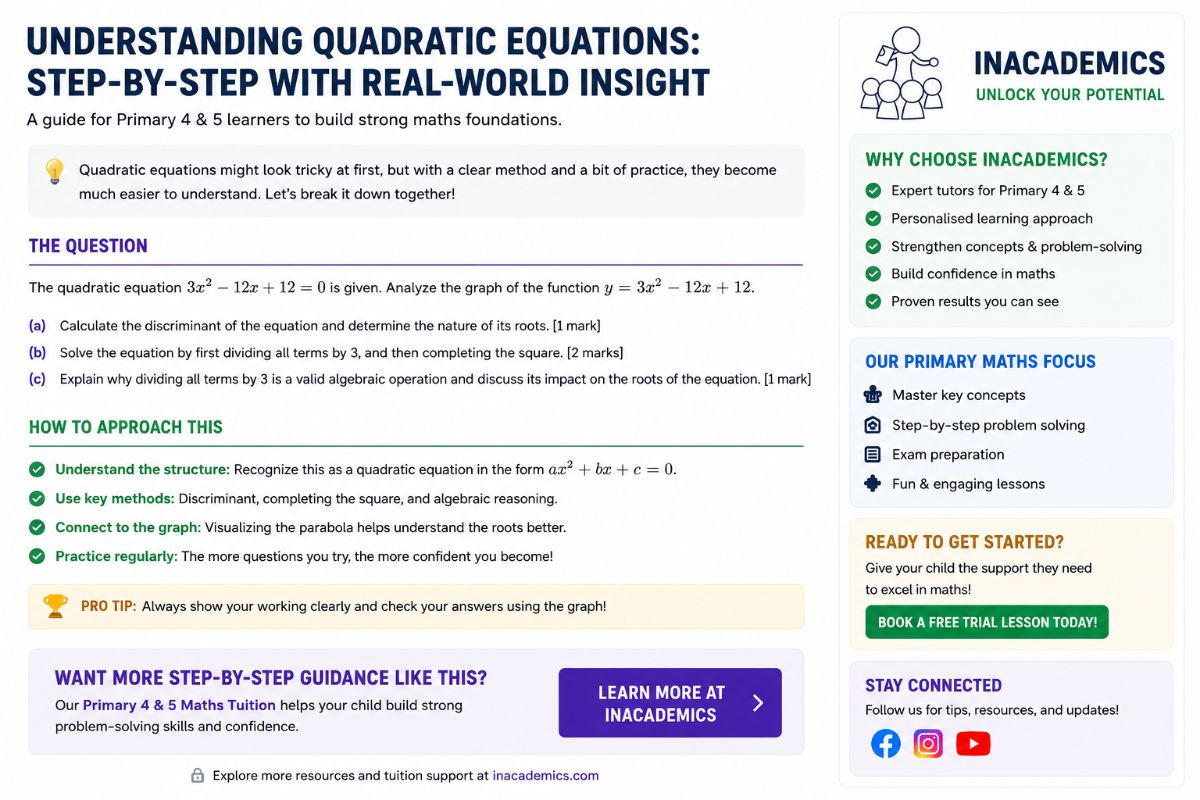
Mathematics is much more than finding answers—it is about understanding patterns, relationships, and the logic behind them. One excellent example is the quadratic equation:
3x² − 12x + 12 = 0
and its corresponding graph:
y = 3x² − 12x + 12
At first glance, this may seem like a standard algebra question. However, it actually brings together several important MYP 4 and MYP 5 Mathematics concepts, including algebraic manipulation, graph interpretation, reasoning, and mathematical communication.
Looking Beyond the Equation
A quadratic equation represents a parabola when graphed. The graph provides valuable information about the solutions of the equation, often called the roots.
In this example, the parabola opens upward because the coefficient of (x^2) is positive. By observing the graph, students can see that the curve touches the x-axis at exactly one point.
This immediately suggests something important about the roots of the equation.
Using the Discriminant to Predict the Roots
For any quadratic equation:
ax² + bx + c = 0
the discriminant is calculated using:
D = b² − 4ac
For the equation:
3x² − 12x + 12 = 0
we identify:
a = 3
b = −12
c = 12
Substituting into the formula:
D = (−12)² − 4(3)(12)
D = 144 − 144
D = 0
What Does D = 0 Mean?
D > 0 → Two distinct real roots
D = 0 → One repeated real root
D < 0 → No real roots
Since D = 0, the equation has exactly one repeated real root.
This explains why the parabola touches the x-axis but does not cross it.
Students often memorize discriminant rules, but understanding how those rules connect to the graph is where true mathematical learning takes place.
Solving by Completing the Square
First divide every term by 3:
x² − 4x + 4 = 0
Recognize that:
x² − 4x + 4 = (x − 2)²
Therefore:
(x − 2)² = 0
Taking the square root of both sides:
x − 2 = 0
x = 2
The solution confirms what the graph already showed: the parabola touches the x-axis at x = 2.
Why Dividing by 3 Works
Many students divide through by 3 automatically without understanding why.
Let's examine the original equation:
3x² − 12x + 12 = 0
Factoring out 3 gives:
3(x² − 4x + 4) = 0
Since 3 is a non-zero number, dividing both sides by 3 preserves the equality.
The equation becomes:
x² − 4x + 4 = 0
The roots remain exactly the same.
This type of reasoning is highly valued in the IB MYP because students are expected not only to calculate answers but also to explain why their methods work.
What This Question Really Assesses
Although the calculations are relatively straightforward, the question evaluates several important mathematical skills:
Understanding the relationship between equations and graphs
Applying the discriminant correctly
Solving quadratics through algebraic methods
Communicating mathematical reasoning clearly
Justifying algebraic operations logically
These are exactly the types of skills that help students move from basic procedural work to higher-level mathematical thinking.
Common Challenges Faced by Students
Many MYP students struggle not because they cannot perform calculations, but because they cannot connect concepts together.
Typical difficulties include:
Confusing the meaning of the discriminant
Making errors while completing the square
Failing to interpret graphs correctly
Treating algebra as a series of disconnected steps
Struggling to explain reasoning in written form
Developing confidence in these areas requires guided practice and exposure to carefully structured questions.
Preparing for Future Mathematics Success
Quadratic equations form the foundation for many advanced topics students will encounter later, including functions, calculus, optimization, and mathematical modelling.
Students who learn to interpret graphs, understand algebraic structures, and explain their reasoning are often far better prepared for the transition from MYP to DP Mathematics.
Rather than focusing only on obtaining the correct answer, successful learners focus on understanding why the mathematics works.
The INACADEMICS Approach
At INACADEMICS, MYP 4 and MYP 5 Mathematics students are encouraged to develop both procedural fluency and conceptual understanding.
Lessons focus on:
Building strong algebraic foundations
Connecting equations to graphical representations
Developing logical mathematical communication
Strengthening problem-solving confidence
Preparing students for future DP Mathematics challenges
When students understand the story behind the mathematics, they become more confident, independent, and successful learners.
A simple quadratic equation may appear ordinary, but it contains many of the mathematical thinking skills that define success in the IB MYP programme.