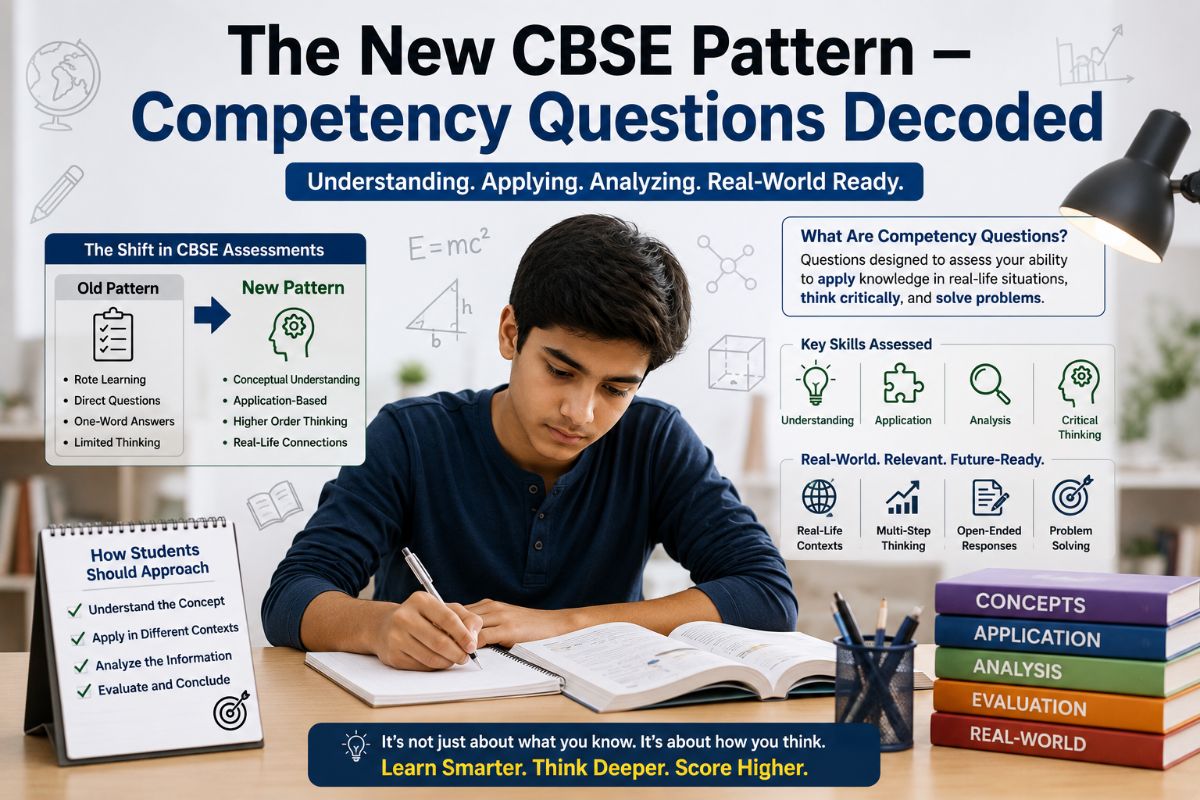
If you have a child in CBSE Class 9 or above and you have looked at a recent question paper — particularly from 2022 onwards — you may have noticed it looks nothing like what you remember from school. The familiar 'state, define, list' questions are a smaller part of the paper. In their place are case studies, assertion-reason pairs, and source-based questions.
This shift is the result of India's National Education Policy (NEP) 2020 implementation, and understanding it is now essential for every CBSE student and parent.
What Has Actually Changed
CBSE has reorganised its question papers across Class 10 and Class 12 (and progressively Class 9) into a competency-based framework. The distribution now roughly looks like:
• 30–40%: Competency-based questions (case study, data analysis, source-based)
• 20–30%: Objective/short-answer questions requiring application, not recall
• 30–40%: Traditional long-answer and numerical questions
The key change is that 'remember and reproduce' no longer gets a student past 60–65%. The remaining marks require the student to apply knowledge to new situations — which is a fundamentally different cognitive task.
The Four New Question Types
1. Case Study / Passage-Based Questions
A 3–5 paragraph passage describing a real-world scenario is followed by 4–5 questions. The passage introduces a context — a manufacturing process, an environmental issue, a social scenario — and the questions ask students to apply subject knowledge to that specific context. The trap is treating this like a reading comprehension exercise — the marks come from applying Biology, Chemistry, Physics, or Mathematics to the passage, not from summarising the passage.
2. Assertion-Reason Questions
Two statements are given: an Assertion (A) and a Reason (R). The student must judge whether each is true and whether R correctly explains A. There are four standard answer options. These questions are particularly powerful at testing whether a student has genuine conceptual understanding or just surface-level recall. A student who has memorised 'mitochondria produce energy' but does not understand ATP synthesis will often answer assertion-reason questions incorrectly.
3. Source-Based / Data Interpretation Questions
A graph, table, diagram, or experimental data set is presented. Students must read the data accurately, identify patterns or anomalies, and draw conclusions. In Sciences, these questions often include asking students to 'suggest an explanation for the anomaly at point X on the graph' — which requires genuine understanding, not memorisation.
4. Competency-Mapped Short Answer Questions
These appear familiar — they are 2–3 mark questions — but they have shifted from 'define osmosis' to 'explain what would happen to a cell placed in a hypertonic solution and justify your answer with reference to osmosis.' The question demands application and justification, not definition.
Why NCERT Alone Is No Longer Enough
NCERT remains the foundation — every concept in CBSE examinations is drawn from the NCERT syllabus. But the competency-based format demands that students can apply NCERT concepts in unfamiliar scenarios. A student who has read and memorised NCERT Class 10 Science will still struggle with case-study questions if they have never practised reading a passage and mapping it to subject concepts.
This is the gap that good CBSE tuition now fills: not just teaching NCERT, but training students to use NCERT knowledge in the competency question format.
How to Prepare Effectively
1. Practice CBSE sample papers from 2022–2025 — the format shift is fully reflected from 2022 onwards.
2. For every chapter studied, practice at least 2 case-study questions from that chapter before moving on.
3. Practise assertion-reason questions by topic cluster — they are significantly easier to answer when you understand the conceptual relationships in a topic.
4. Never skip data interpretation in Sciences. Graph reading is a skill — practice it independently from subject content revision.
5. Time yourself. Competency questions take longer per mark than traditional questions. Students who have not timed themselves consistently run out of time in the board exam.
What INACADEMICS Does Differently for CBSE
INACADEMICS's CBSE teaching is NCERT-first — but it does not stop at NCERT. Our CBSE faculty specifically train students in competency question formats: reading case studies under time pressure, structuring assertion-reason answers, and extracting data from graphs. Our mock cycles include full-pattern papers mirroring the current CBSE blueprint — so students sit their actual board exam having already experienced this format multiple times.
Ready to give your child the right guidance? INACADEMICS in Kokapet, Hyderabad has been helping IB MYP, IGCSE, ICSE, and CBSE students achieve their best since 2009. Small batches, certified teachers, and a proven track record — book a free counselling session today.
INACADEMICS · Kokapet, Hyderabad · inacademics.com