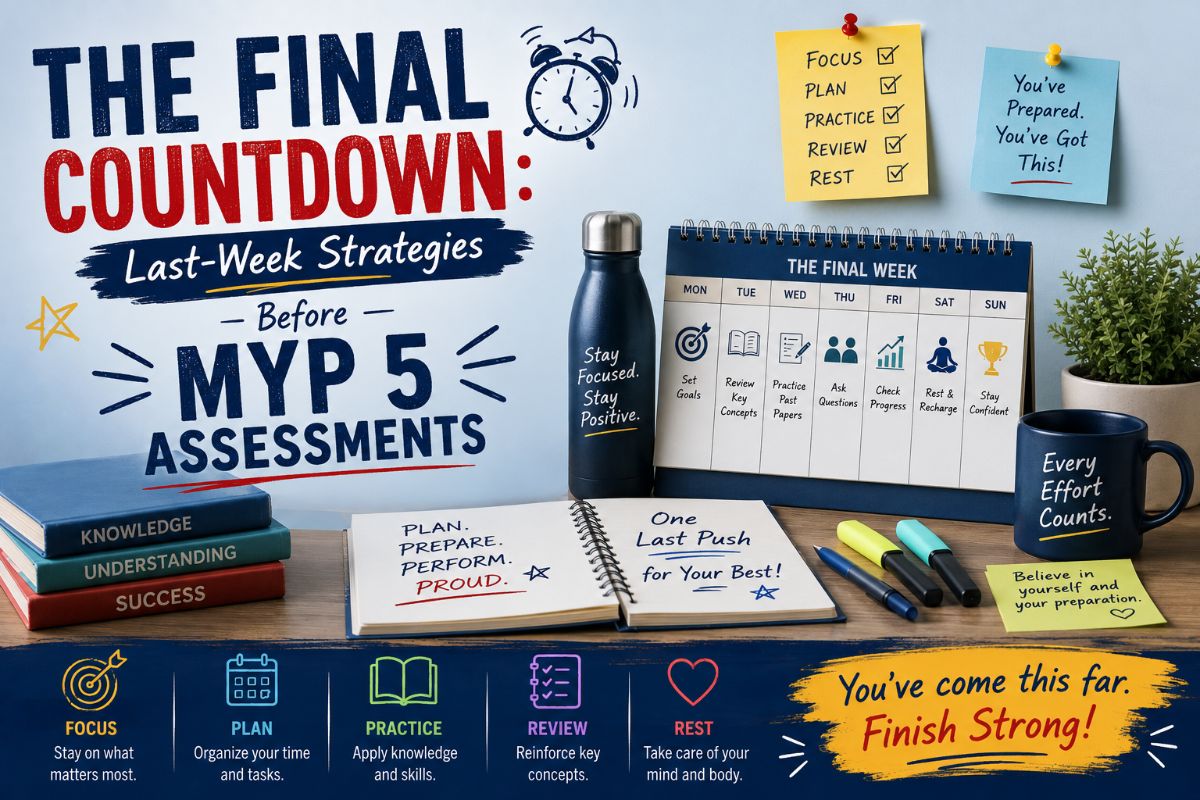
Shifting from Learning to Consolidation
The week before a major MYP 5 assessment is not the time to learn new content — it is the time to consolidate, review, and build confidence. One of the most damaging last-minute strategies students employ is attempting to cram new material, which creates cognitive overload and anxiety without meaningfully improving performance. As a parent, your role in the final week is to help your child shift from a learning mode to a consolidation mode.
Help your child audit what they know well, what they are uncertain about, and what they have not yet covered. Allocate the final week's study time proportionally — more time to areas of genuine uncertainty, less to areas of confidence. A quick review of strong areas maintains recall without wasting time, while targeted work on weak areas produces the highest return.
The Day-by-Day Final Week Framework
Day
Activity
Evening
Day 7 (1 week before)
Full subject audit: categorise topics as Strong / Shaky / Unreviewed
Light review of one strong topic
Day 6
Deep revision of top 3 unreviewed or shaky topics
Practice past questions on these topics
Day 5
Continue targeted revision; create summary sheets
Test yourself using flashcards or practice questions
Day 4
Review summary sheets; begin consolidating key formulas, quotes, dates
Light exercise; early night
Day 3
Attempt a timed practice paper under exam conditions
Mark and review; note errors for final review
Day 2
Final targeted review of error patterns identified; review Personal Project criteria
Relaxed evening; prepare materials
Day 1 (eve of exam)
Light review only — 30-45 minutes maximum
Early dinner, sleep by 9:30 PM
Managing Exam Day Logistics
Exam day logistics, though seemingly minor, have a disproportionate impact on student performance. The night before: lay out all required materials (pens, pencils, ruler, calculator, ID card, any permitted notes), confirm the exam location and start time, and agree on transport arrangements. The morning of: ensure a protein-rich breakfast, allow adequate time so there is no rushing, and avoid intense academic discussion in the car or at breakfast — this window is for calm, not cramming.
The Emotional Debrief: After the Assessment
How parents respond immediately after an assessment significantly shapes their child's emotional resilience and attitude toward subsequent exams. The first question should never be 'How do you think you did?' or 'Did you remember to write about X?' Instead, ask: 'How are you feeling? Is there anything you want to talk about?' Let your child lead. If they want to debrief on the paper, engage supportively. If they want to move on, support that too.
Avoid asking teachers or peers for exam content to compare with what your child wrote — this creates anxiety about a paper that is now unchangeable. Focus energy forward: what is the next assessment, and what can be done now to prepare well?
Celebrating the Journey
MYP 5 is one of the most demanding years of a young person's academic life. It requires intellectual rigour, personal discipline, creative thinking, and emotional resilience. When it is over — whether the results are exactly as hoped or not — take time as a family to acknowledge the journey. The habits, skills, and self-knowledge your child has developed during MYP 5 will serve them far beyond any set of grades.
The IB's vision is not simply to produce students who perform well in examinations. It is to develop young people who are principled, balanced, reflective thinkers who care about the world and their role in it. As a parent who has walked alongside your child through MYP 5, you have contributed to that vision. That is worth celebrating.
💡 Final Word: Your child needs to know — not just believe, but know — that your love and pride are not conditional on their MYP 5 results. Say it explicitly. Say it often. It is the