One of the biggest challenges in teaching IB MYP Chemistry is helping students understand that science is not just about calculations and laboratory skills. The strongest MYP learners can connect scientific knowledge to real-world decisions, evaluate impacts on society, and discuss limitations of scientific models.
The sulfuric acid copper-mining question above is an excellent example of how a single task can be used to assess multiple MYP Chemistry criteria simultaneously.
Why This Question Works
At first glance, students appear to be solving a straightforward dilution problem:
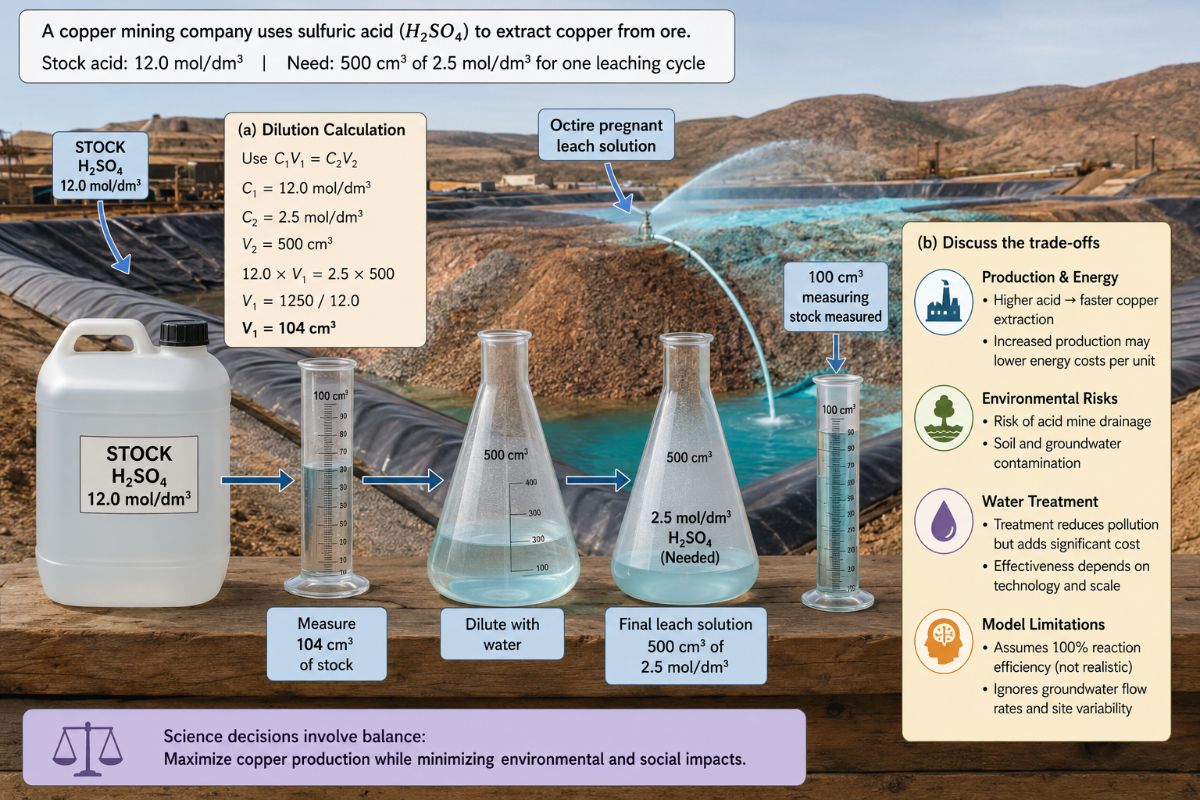
Stock sulfuric acid concentration = 12.0 mol dm⁻³
Required concentration = 2.5 mol dm⁻³
Final volume = 500 cm³
Students apply the dilution equation:
C₁V₁ = C₂V₂
Substituting values:
12.0 × V₁ = 2.5 × 500
V₁ = 104 cm³
This calculation assesses students' ability to apply chemical knowledge and mathematical relationships.
However, the question then extends far beyond simple calculations.
Moving Beyond Criterion B
Many traditional chemistry questions stop once the numerical answer is obtained.
The MYP framework encourages students to ask:
Why is this concentration being used?
What are the consequences of choosing a different concentration?
How does this decision affect people and the environment?
These questions shift learning toward scientific inquiry and evaluation.
Developing Criterion D: Reflecting on the Impacts of Science
The second part of the task asks students to evaluate the use of higher and lower sulfuric acid concentrations in copper extraction.
This is a classic Criterion D opportunity because there is no single correct answer.
Students must analyse competing factors.
Benefit: Increased Copper Production
Higher acid concentrations may:
Increase reaction rates.
Improve extraction efficiency.
Reduce processing time.
Increase economic productivity.
Students can discuss how faster extraction may lower operational costs and increase the availability of copper used in infrastructure, electronics, and renewable energy technologies.
Risk: Environmental Damage
Higher acid concentrations also introduce risks:
Acid mine drainage.
Soil contamination.
Groundwater pollution.
Damage to local ecosystems.
Students begin to understand that scientific decisions often involve balancing benefits against risks.
Evaluating Water Treatment Solutions
Students can explore mitigation strategies such as:
Neutralisation with alkaline compounds.
Wastewater treatment systems.
Containment barriers.
Environmental monitoring programmes.
Here students evaluate both effectiveness and economic cost, an important component of Criterion D.
Teaching Scientific Model Limitations
One of the strongest aspects of this question is the requirement to discuss model limitations.
Students often assume calculations provide perfect answers.
Real industrial systems rarely behave exactly as predicted.
For example:
Assumption 1: 100% Reaction Efficiency
The dilution calculation assumes perfect mixing and no losses.
In reality:
Some acid may react with impurities.
Handling losses may occur.
Concentrations may vary slightly.
Assumption 2: Ignoring Groundwater Flow
Environmental models often simplify groundwater movement.
However:
Water flows through different rock layers.
Seasonal rainfall affects contamination spread.
Geological conditions vary from site to site.
Students learn that scientific models are useful tools but are never perfect representations of reality.
Cross-Criterion Learning
This single task can support multiple MYP Chemistry criteria:
Criterion B: Inquiring and Designing
Students investigate:
How acid concentration affects extraction efficiency.
Variables affecting reaction rates.
Environmental monitoring methods.
Criterion C: Processing and Evaluating
Students:
Perform dilution calculations.
Interpret concentration data.
Evaluate reliability of results.
Criterion D: Reflecting on the Impacts of Science
Students:
Assess societal benefits.
Consider environmental consequences.
Evaluate sustainable solutions.
Discuss limitations of scientific models.
Why Real-World Context Matters
Students often ask:
"When will I ever use chemistry?"
Mining, water treatment, environmental protection, battery production, and renewable energy all depend heavily on chemical principles.
When chemistry is taught through authentic scenarios, students see science as a tool for solving real problems rather than simply memorising formulas.
This is exactly the type of thinking encouraged by the IB MYP framework.
The goal is not only to create students who can calculate concentrations but students who can evaluate evidence, consider multiple perspectives, and make informed decisions about the world around them.