Mathematics
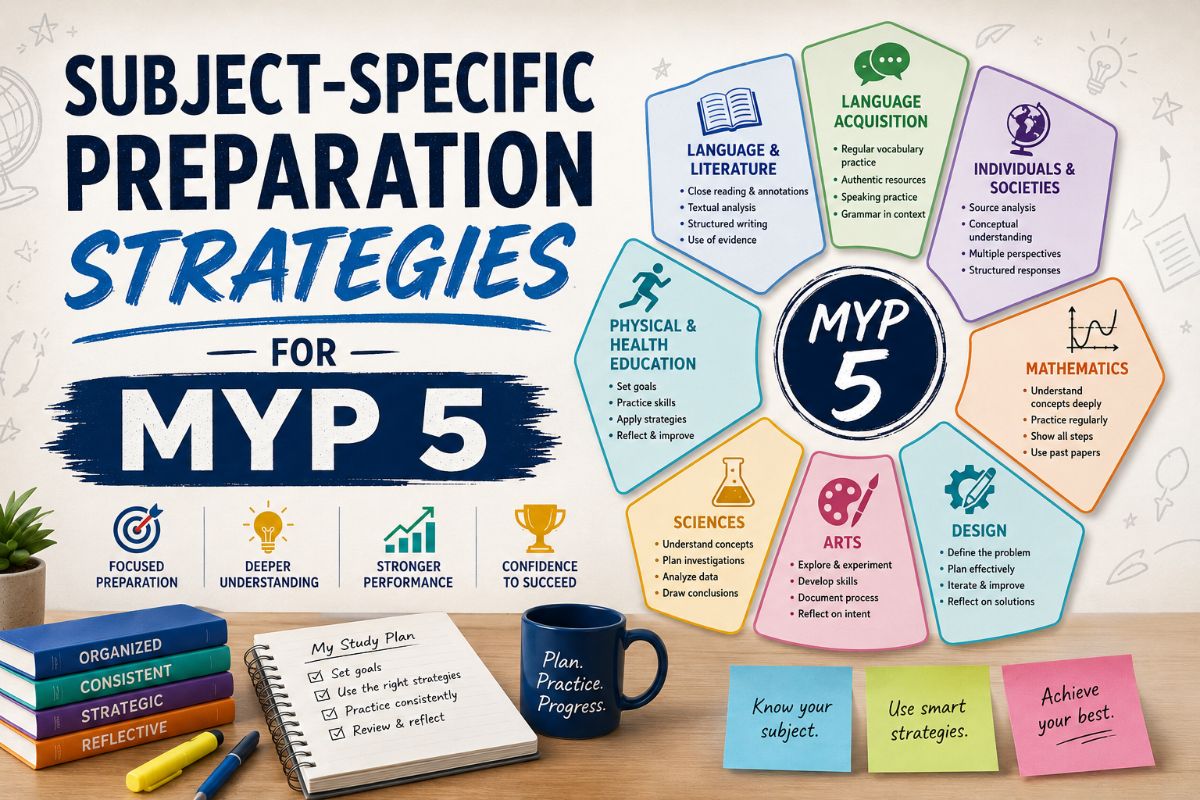
Mathematics in MYP 5 is assessed on four criteria: Knowing and Understanding, Investigating Patterns, Communicating, and Applying Mathematics in Real-World Contexts. The most effective revision strategy for Mathematics is spaced practice — working through problems regularly rather than in single marathon sessions. Encourage your child to keep an 'error journal' where they record mistakes and the correct approach. Revisiting this journal before assessments is far more effective than re-reading notes.
Khan Academy, IB-specific platforms like Revision Village (for those preparing for the DP transition), and school-provided practice papers are invaluable. Ensure your child understands the reasoning behind each method, not just the steps — MYP assessments increasingly demand conceptual explanation, not just numerical answers.
Sciences
MYP Sciences — including Biology, Chemistry, Physics, and Environmental Systems — are assessed on Knowing and Understanding, Inquiring and Designing, Processing and Evaluating, and Reflecting on the Impacts of Science. The laboratory component (Criterion B and C) is often where students lose marks. Encourage your child to treat every lab as an assessed opportunity, paying close attention to writing clear hypotheses, identifying variables correctly, and drawing data-driven conclusions.
For the knowledge components, concept maps are highly effective. Help your child create visual maps linking key terms, principles, and real-world applications. This approach suits both visual and analytical learners.
Language and Literature
Language and Literature assessments typically involve analysis of literary and non-literary texts, as well as creative writing. The four MYP criteria cover Analysing, Organising, Producing Text, and Using Language. Encourage wide reading beyond the set texts — exposure to varied writing styles strengthens both analytical and creative responses. Model the habit of asking interpretive questions during family reading or movie discussions: 'Why do you think the author made that choice? What does that symbol represent?'
Individuals and Societies (Humanities)
This subject group covers History, Geography, Economics, and Social and Cultural Studies, among others. Its criteria include Knowing and Understanding, Investigating, Communicating, and Thinking Critically. The most common weakness here is the ability to evaluate sources and construct evidence-based arguments. Encourage your child to engage with current affairs through quality journalism and to practise identifying bias, purpose, and context in information sources.
Design
Design in MYP 5 follows the Design Cycle: Inquiring and Analysing, Developing Ideas, Creating the Solution, and Evaluating. Students often struggle with the Evaluation criterion, which requires them to test their product against their original design specifications. Encourage rigorous self-assessment throughout the creation process rather than leaving evaluation until the product is complete.
💡 Parent Strategy: For each subject, ask your child to explain one concept to you each week as if you know nothing about it. The Feynman Technique — teaching what you know — is one of the most powerful revision strategies available. You don't need to understand the concept; you just need to listen and ask clarifying questions.