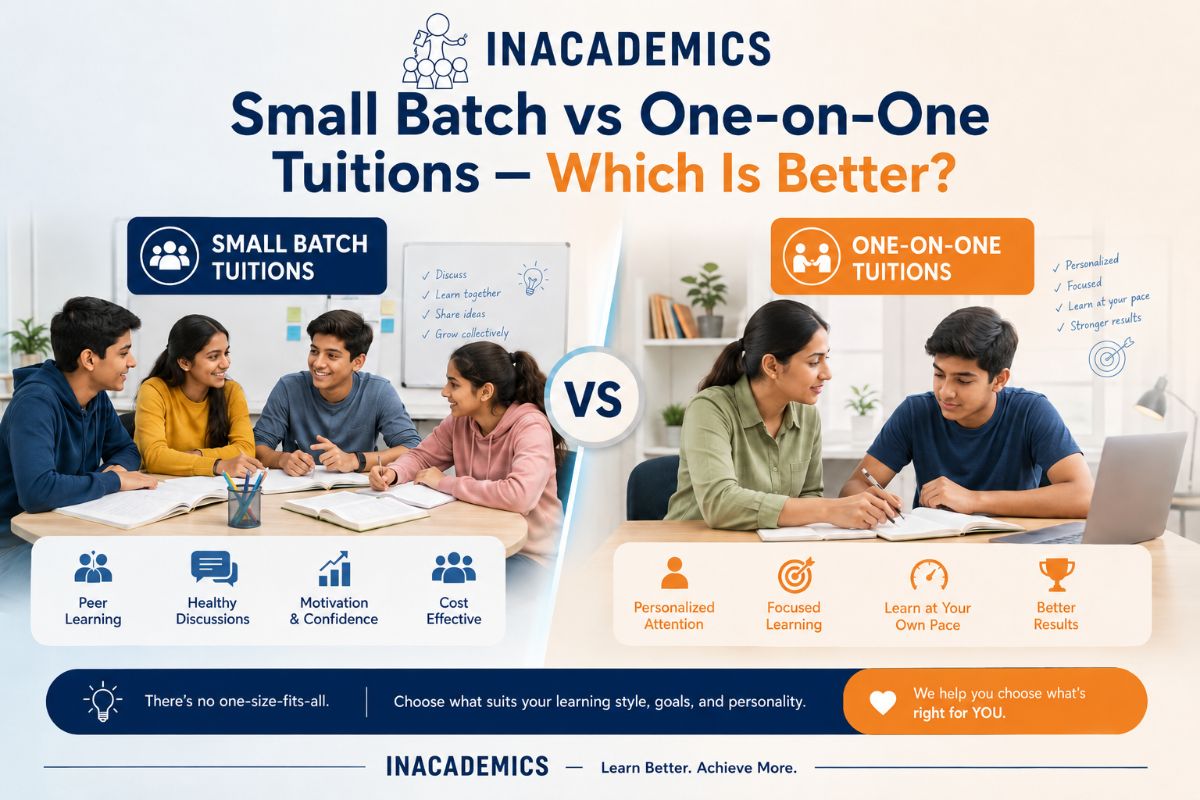
Ask most parents what kind of tuition they want for their child and the answer is instant: 'One-on-one, obviously.' The logic feels airtight — more teacher time, more personalised attention, better results.
The reality is more nuanced. For most students, a well-run small batch of 4–8 students produces better outcomes than one-on-one tuition — and for specific reasons that one-on-one cannot replicate.
What One-on-One Tuition Does Well
One-on-one tuition has genuine advantages in specific situations:
• Very young children (Grade 5 and below) who need highly individualised pacing
• Students with specific learning differences that require modified instruction
• Emergency intervention in the final 4–6 weeks before a major exam, where a very focused drill is needed
• Students with extreme schedules who cannot synchronise with a batch group
Outside of these cases, the advantages of one-on-one are often overstated — and its disadvantages are rarely discussed.
The Hidden Weaknesses of One-on-One
The 'Performance Trap'
In a one-on-one setting, many students quickly learn to follow the teacher's cues rather than independently retrieve knowledge. The teacher asks 'So what happens next?' and gives a slight nod when the answer starts going right. The student looks attentive and productive — but is being guided more than they realise. In a group setting, students must actually retrieve and express their understanding without constant micro-cues from the teacher.
No Benchmark, No Drive
When a student is the only person in the room, there is no natural motivation benchmark. A student who does not know the answer to a question only has to deal with the teacher's mild disappointment — a manageable and easily rationalised experience. In a small group, a peer knowing the answer creates a social motivation to catch up that no teacher can manufacture.
Price vs. Frequency
One-on-one tuition typically costs 2–3x more per session. In practice, this means families often buy fewer sessions per week, which reduces total learning time. A student attending three small-batch sessions per week at lower cost often gets more contact hours than a student attending one or two one-on-one sessions.
What a Small Batch of 4–8 Does Uniquely Well
Peer Questioning
When one student asks a question that the others did not know to ask, the whole group benefits. This is not replicable in one-on-one. The diversity of confusion in a small group is educationally valuable — it surfaces gaps the teacher might not have anticipated.
Collaborative Problem-Solving
For MYP Sciences and Mathematics, and for IGCSE extended-response questions, students who have worked through problems in a small group — arguing, correcting each other, debating approaches — perform measurably better in exams than students who only worked with a single teacher. Explaining a concept to a peer is one of the most powerful revision techniques known to learning science.
Social Safety in Making Mistakes
A well-managed small batch (4–8 students, not 20) has enough social density that making a mistake feels normal, not singular. This matters enormously for students with test anxiety or low confidence — they see peers making mistakes too, recover faster, and become more willing to attempt difficult problems.
Teacher Bandwidth for Actual Teaching
Paradoxically, a teacher in a 6-student batch often teaches more effectively than in one-on-one. One-on-one sessions can drift into homework-helping mode — the student works, the teacher watches and corrects. In a batch, the teacher must deliver structured content, which creates better lessons.
When to Choose One-on-One
After all of the above, there are still clear cases where one-on-one is the right call:
• Your child has been diagnosed with a learning difference (dyslexia, dyscalculia, ADHD) that requires highly adapted pacing
• A very focused emergency catch-up is needed in one specific subject before an imminent exam
• The student is significantly above grade level and needs material that would not be covered in any batch group
The INACADEMICS Model: 4–8 Students, Not More
INACADEMICS deliberately caps batches at 8 students. Not 12. Not 'up to 15 if demand is high'. The 4–8 range is the zone where individual feedback is still possible within every session — the teacher can mark a student's written response, ask a follow-up question, and address a specific criterion gap in the same 90-minute class.
This is why the question 'small batch or one-on-one' often resolves cleanly at INACADEMICS: the batch size is small enough that many of the benefits of one-on-one are already present — with all the additional benefits of peer learning layered on top.
Ready to give your child the right guidance? INACADEMICS in Kokapet, Hyderabad has been helping IB MYP, IGCSE, ICSE, and CBSE students achieve their best since 2009. Small batches, certified teachers, and a proven track record — book a free counselling session today.
INACADEMICS · Kokapet, Hyderabad · inacademics.com