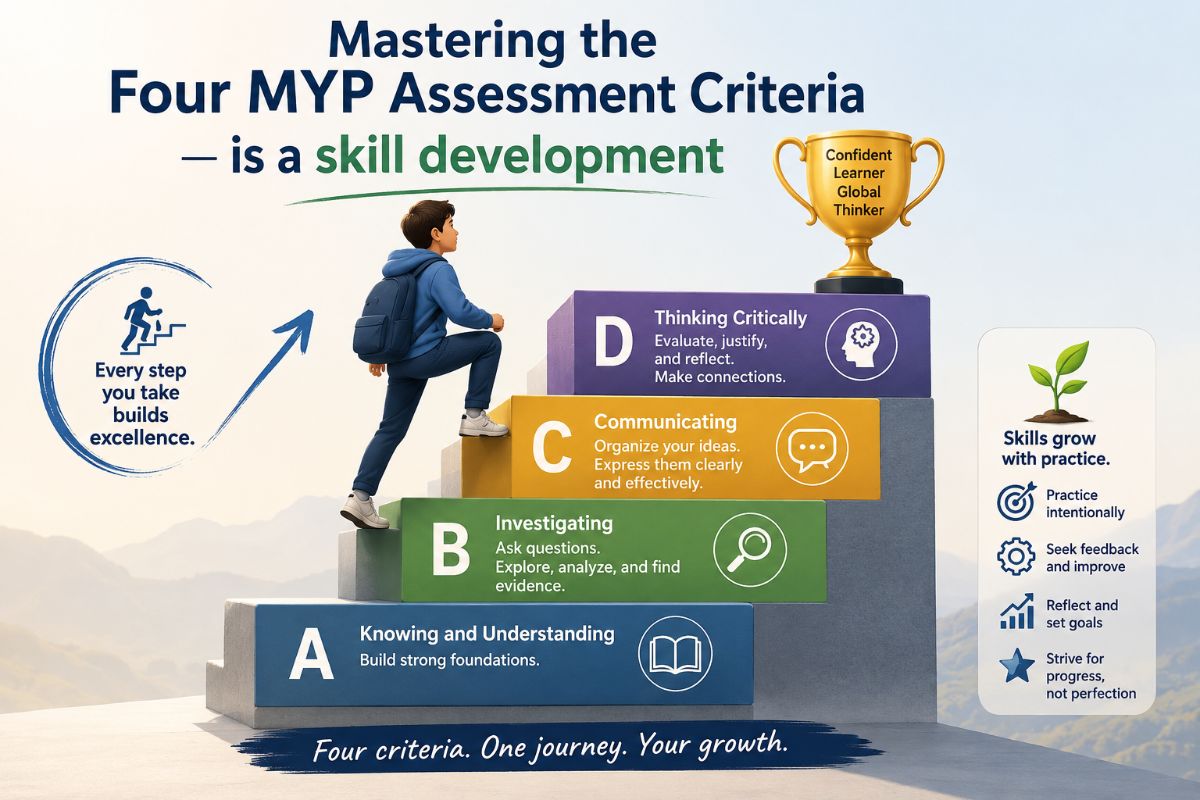
The MYP's four assessment criteria are the heart of everything — every question, every mark, and every rubric descriptor connects back to them. Yet most students approach their MYP work without a systematic understanding of what each criterion actually demands. They write answers. They submit reports. They hope for good marks.
This guide is for students and parents who want to understand the criteria deeply enough to actively target marks — not passively hope for them.
The Four Criteria — The Foundation
All MYP subjects are assessed on four criteria, each marked 0–8. The specific names differ by subject group, but the underlying logic is consistent:
• Criterion A — Knowledge and Understanding: Can you recall, define, apply, and connect subject content accurately?
• Criterion B — Investigating / Inquiring and Designing: Can you design investigations, formulate research questions, or plan experiments?
• Criterion C — Processing and Evaluating / Communicating: Can you analyse data, draw conclusions, and present your thinking clearly and precisely?
• Criterion D — Reflecting on the Impacts: Can you connect your learning to broader real-world, ethical, or personal contexts?
How the Criteria Differ by Subject
MYP Mathematics
In Mathematics, the four criteria are: (A) Knowing and Understanding, (B) Investigating Patterns, (C) Communicating, (D) Applying Mathematics in Real-life Contexts. The critical misconception students have is treating this like a CBSE or ICSE Maths paper — solve the problem, write the answer. The MYP expects far more: Criterion B requires you to notice a pattern, conjecture what it means, test it, and justify your reasoning in writing. Criterion C requires a complete, structured communication of your working, not just the final answer. Criterion D requires connecting the mathematics to an actual real-world application — not a contrived 'a shopkeeper has 10 mangoes' scenario, but a genuine context with reflection.
MYP Sciences (Physics, Chemistry, Biology)
Sciences have the most elaborate criterion framework because of the practical component. Criterion B (Inquiring and Designing) is where students most often lose marks — they write a procedure but don't justify their method choices or identify variables clearly. The mark band descriptors require students to write about why they chose a particular independent variable, what variables were controlled and how, and what safety measures were taken. This is not taught in most traditional tuition centres.
Criterion D (Reflecting on the Impacts of Science) requires discussing ethical, social, environmental, or economic implications of the scientific concept studied. A student who writes a technically perfect lab report but ignores Criterion D cannot score above a 4 in that criterion — which pulls the final grade down significantly.
Individuals and Societies (I&S)
I&S uses criteria A (Knowing and Understanding), B (Investigating), C (Communicating), D (Thinking Critically). Criterion D in I&S is specifically about evaluating multiple perspectives, identifying bias, and assessing the reliability of sources. Students who give only one perspective — even if well-argued — cannot access the top mark band.
The Mark Bands — Reading the Rubric Like an Examiner
The most powerful study technique for MYP is to read the mark band descriptors before writing, not after. For each criterion, the IB publishes descriptors for each band (1–2, 3–4, 5–6, 7–8). The difference between a 5–6 and a 7–8 is almost always precision of language and completeness of response.
For example, in MYP Sciences Criterion A, the difference between a 5–6 and a 7–8 typically comes down to whether the student 'applies' knowledge to a familiar context (5–6) or 'applies' it with justification to a new, unfamiliar context (7–8). Students who do not know this distinction will always plateau at 5–6.
Command Terms — The Unspoken Criterion
Every MYP question uses a command term: Describe, Explain, Outline, Justify, Evaluate, Analyse, Discuss. Each demands a different type and depth of response:
• Describe: State facts, features, or characteristics. No explanation required.
• Explain: Describe AND give reasons or mechanisms. 'Because' or 'since' should appear.
• Justify: Give reasons AND convince the reader the conclusion is correct.
• Evaluate: Weigh up evidence and come to a reasoned conclusion, acknowledging limitations.
• Analyse: Break down into components and examine each, showing how they relate.
A student who 'explains' when the question asks to 'justify' has answered the wrong question — regardless of how good their explanation is.
Common Mistakes by Criterion
Criterion A
Using everyday language instead of subject-specific terminology. Writing 'the liquid heats up and moves faster' instead of 'as temperature increases, the kinetic energy of the particles increases, resulting in faster molecular motion.' Both say the same thing, but only one accesses the upper mark bands.
Criterion B
Writing a method (what you will do) without an experimental design (why you chose this method, what variables exist, how variables are controlled). The design justification is what separates a 4 from a 6–8.
Criterion C
Presenting data without interpreting it. Saying 'the temperature increased from 20°C to 45°C as shown in the graph' is narrating a graph. Criterion C requires analysis: 'The temperature increased by 25°C over 10 minutes, suggesting a consistent rate of energy transfer. However, the gradient decreases after the 8-minute mark, which may indicate...'
Criterion D
Writing a superficial connection to the real world. 'This is important because we use electricity every day' scores near zero. A genuine Criterion D response names specific industries, ethical debates, or social groups affected — and reflects on them with depth.
Ready to give your child the right guidance? INACADEMICS in Kokapet, Hyderabad has been helping IB MYP, IGCSE, ICSE, and CBSE students achieve their best since 2009. Small batches, certified teachers, and a proven track record — book a free counselling session today.
INACADEMICS · Kokapet, Hyderabad · inacademics.com