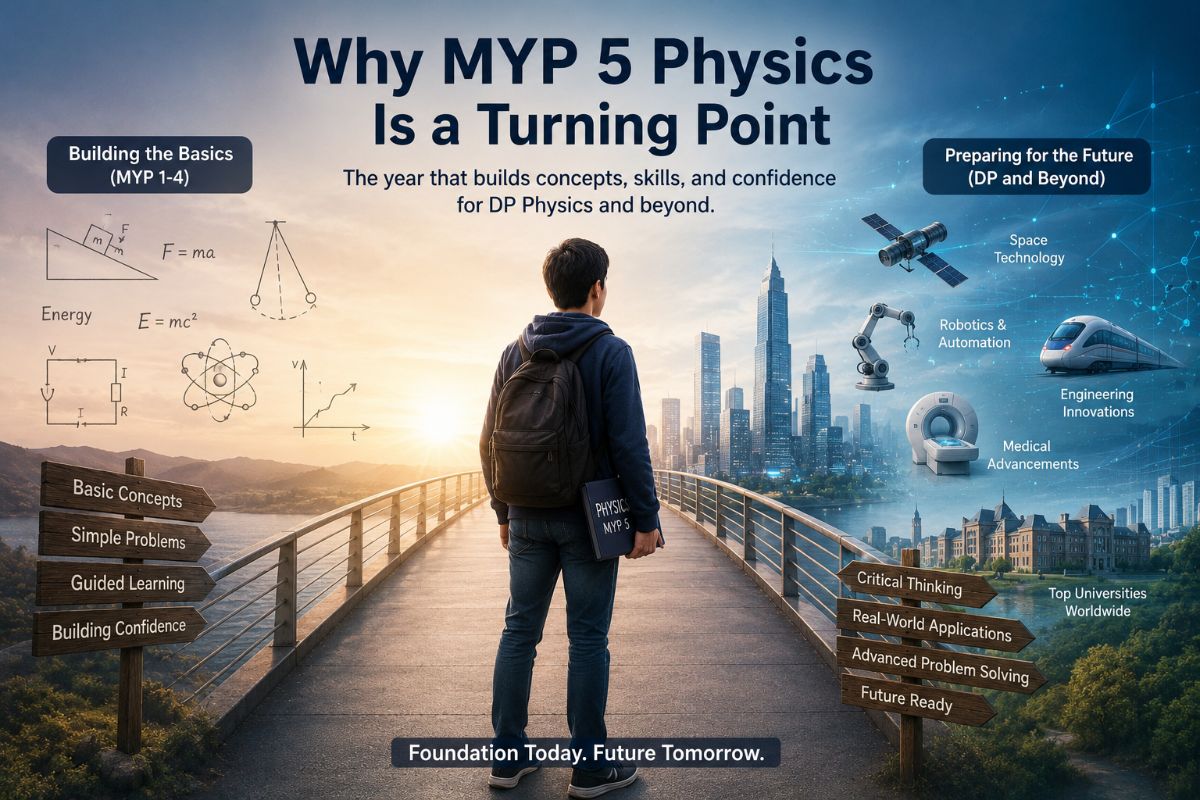
MYP Year 5 (Grade 10) is the final year of the IB Middle Years Programme, and Physics in this year carries exceptional weight. For students at IB schools across Hyderabad — including Oakridge International, The Gaudium, CHIREC International, Rockwell International, Indus International, Sri Nidhi International, and Shri Ram Universal School — the MYP 5 Physics on-screen eAssessment is both a credentialling milestone and a direct bridge to IB DP Physics (Grades 11–12).
The IB's MYP eAssessment for Physics tests students across six major topic domains in a 2-hour on-screen examination. Questions are criterion-based, progressing from recall (Criterion A: Knowing & Understanding) through investigation design (Criterion B) and data analysis (Criterion C) to evaluation and real-world reflection (Criterion D). A student who understands why physics works — not just how to recall formulae — consistently outperforms those who rely on rote memorisation.
At INACADEMICS (Kokapet, Hyderabad), our small-batch MYP 5 Physics classes are structured around exactly this taxonomy. This guide mirrors the pedagogy we use in our classroom: concept-first, formula second, application always.
Section 1 — The Official MYP 5 Physics Topic Map
The IB's MYP Physics eAssessment topic list covers six broad domains. Every sub-bullet is assessable and has appeared in past on-screen examinations.
Domain
Sub-Topics
Assessment Focus
Forces & Energy
Measurement; states of matter; kinetic theory; density
Foundation for all mechanics
Forces & Energy
Forces, effects of forces; Newton's Laws; pressure
Criterion A/B favourite
Forces & Energy
Work, power, efficiency; gravitational fields
High-yield calculation topic
Forces & Energy
Energy sources & resources; fuels & environmental impact
Links to global context (climate)
Electromagnetism
Magnetism; electric & magnetic fields; static electricity
Conceptual + diagram questions
Electromagnetism
EM forces & induction; AC and DC current
Generator/transformer problems
Electromagnetism
Voltage, power, generation & transmission; electric circuits
Circuit analysis — most-tested sub-topic
Astrophysics
Solar system; planets & satellites; Big Bang theory
Criterion D context questions
Heat, Light & Sound
Thermal physics; heat transfer; condensation & evaporation
Criterion A definitions & graphs
Waves
Longitudinal & transverse waves; sound waves; wave equation
v = fλ always assessed
Waves
Reflection, refraction, diffraction; EM spectrum & applications
Ray diagrams + Snell's law
Atomic Physics
Atomic structure; subatomic particles; charges and masses
AO1 knowledge questions
Atomic Physics
Radioactivity; decay; half-life; forms of radiation
Half-life graph & calculations
Atomic Physics
Uses and dangers of radiation; nuclear energy
Criterion D evaluation tasks
INACADEMICS Classroom Insight: We allocate roughly 30% of teaching time to Waves + Electromagnetism because these two domains generate the highest density of 7-and-8 boundary marks in the eAssessment. Do not under-prepare Atomic Physics — Criterion D essay-style questions on ethical use of nuclear energy are consistent across eAssessment sessions.
Section 2 — Forces & Energy: The Mechanics Foundation
Forces and Energy is the largest domain by sub-topic count and underpins every subsequent topic in MYP 5 Physics. A shaky understanding of Newton's Laws, for example, will cascade into errors on electromagnetic force questions later.
2.1 Newton's Three Laws — Concept-to-Criterion Mapping
Newton's First Law (Inertia): An object remains at rest or moves with constant velocity unless acted on by a net external force. In MYP assessments, this law typically appears in Criterion A 'state' questions (1–2 marks) or as the conceptual justification for Criterion D real-world analysis (e.g., seatbelt design, aircraft cruising).
Newton's Second Law (F = ma): Net force = mass × acceleration. This is the most calculation-heavy law in MYP 5. Expect multi-step problems: find net force from multiple applied forces, friction, and weight, then calculate acceleration. Always use SI units (N, kg, m s⁻²).
Newton's Third Law (Action–Reaction): For every action force, there is an equal and opposite reaction force acting on a different body. MYP Criterion D questions frequently probe misconceptions here — students wrongly cancel action–reaction pairs when analysing a single body.
2.2 Key Formulae Table
Quantity
Formula / Relationship
Weight
W = mg
Net Force
F_net = ma
Pressure
P = F / A
Work
W = Fd cos θ
Power
P = W / t = Fv
Efficiency
η = (useful output energy / total input energy) × 100%
Kinetic Energy
KE = ½mv²
Gravitational PE
GPE = mgh
Conservation
KE₁ + GPE₁ = KE₂ + GPE₂ (no friction)
2.3 Energy Sources & Environmental Impact
This sub-topic is a consistent Criterion D target because it links physics directly to the MYP global context of 'Globalisation and Sustainability'. Students must be able to:
• Distinguish between renewable (solar, wind, hydro, tidal, geothermal) and non-renewable (fossil fuels, nuclear fission) energy sources
• Discuss the trade-offs: reliability, land use, carbon footprint, energy density, and ecological impact
• Apply efficiency calculations to real scenarios (e.g., a coal power plant with 35% efficiency and 600 MW output requires what fuel burn rate?)
• Evaluate whether a solution is scientifically viable AND ethically justifiable — this requires AO3 thinking, not formula recall
INACADEMICS Exam Tip: For Criterion D 'evaluate' questions on energy, structure your answer as: (1) scientific claim → (2) supporting evidence → (3) limitation → (4) conclusion. IB examiners allocate marks across all four elements. Missing any one drops you from a 7 to a 5.
Section 3 — Electromagnetism: Circuits, Fields, and Induction
Electromagnetism is frequently the topic where Grade 10 students lose the most marks in the eAssessment — not because the concepts are hardest, but because students underestimate circuit analysis and confuse electric and magnetic field diagrams.
3.1 Electric Circuits — Series vs Parallel
Property
Series Circuit
Parallel Circuit
Current
Same throughout all components
Different in each branch; adds to give total
Voltage
Divides across components (sum = supply)
Same across all branches
Resistance
R_total = R₁ + R₂ + R₃
1/R_total = 1/R₁ + 1/R₂ + 1/R₃
Effect of removing one component
All components stop working
Others continue — real-world: house circuits
Total power
P = VI = I²R = V²/R (same I)
P = VI (same V, different I per branch)
3.2 Electromagnetic Induction — How Generators Work
Faraday's Law states that an e.m.f. is induced in a conductor whenever the magnetic flux through it changes. The magnitude of the induced e.m.f. is proportional to the rate of change of magnetic flux. Lenz's Law adds the direction: the induced current opposes the change causing it.
Increasing induced e.m.f.: Move the magnet faster; use a stronger magnet; increase the number of coil turns; use a ferromagnetic core (iron) inside the coil.
Transformers: Step-up transformers increase voltage (and decrease current) for efficient long-distance power transmission. Step-down transformers reduce voltage for safe domestic use. The relationship is: V_p/V_s = N_p/N_s = I_s/I_p (for an ideal transformer).
3.3 Key Formulae — Electromagnetism
Quantity
Relationship
Ohm's Law
V = IR
Power
P = VI = I²R = V²/R
Energy transferred
E = VIt = Pt
Transformer ratio
V_p / V_s = N_p / N_s
Transformer (ideal)
V_p I_p = V_s I_s
Charge
Q = It
Section 4 — Waves: The Most Diagram-Heavy Topic
Waves is the topic where a student's ability to draw and read diagrams most directly correlates with marks. The IB MYP eAssessment consistently tests Snell's Law, the wave equation, and diffraction — all of which require both conceptual understanding and numeric accuracy.
4.1 Transverse vs Longitudinal Waves
Property
Transverse
Longitudinal
Wave type
Transverse
Longitudinal
Particle motion
Perpendicular to wave propagation
Parallel to wave propagation
Examples
Light, water surface waves, seismic S-waves
Sound, ultrasound, seismic P-waves
Can travel in vacuum?
Yes (electromagnetic waves)
No — requires a medium
Diagram feature
Shows crests and troughs
Shows compressions and rarefactions
4.2 The Wave Equation
v = f λ
v = wave speed (m s⁻¹) | f = frequency (Hz) | λ = wavelength (m)
This equation is the single most-tested formula in MYP 5 Physics waves. Always check that units are consistent before substituting. A common error: mixing cm and m for wavelength, giving a speed answer out by a factor of 100.
4.3 Reflection and Refraction
Reflection: The angle of incidence equals the angle of reflection, both measured from the normal to the surface. In MYP assessments, students must construct accurate ray diagrams — a protractor error of more than 2° typically costs a mark.
Refraction: When a wave moves from one medium to another, its speed changes and (unless it hits the boundary at 90°) its direction changes. Snell's Law governs this:
n₁ sin θ₁ = n₂ sin θ₂
n₁, n₂ = refractive indices of media 1 and 2 | θ₁, θ₂ = angles to the normal
Total Internal Reflection (TIR): When a ray in a denser medium hits the boundary at or beyond the critical angle (sin c = n₂/n₁), it is entirely reflected. TIR is the physics principle behind optical fibres used in endoscopes and broadband internet.
4.4 Diffraction
Diffraction is the spreading of waves as they pass through a gap or around an obstacle. The effect is most pronounced when the gap width is approximately equal to the wavelength. In MYP, students must explain:
• Why radio waves (long wavelength ~1 m) diffract around hills but light (λ ~ 500 nm) does not
• Why a narrower gap produces more diffraction (the waves spread over a wider angle)
• Real-world applications: sonar, radar, single-slit diffraction patterns in optics
4.5 The Electromagnetic Spectrum
Wave Type & Wavelength
Key Applications
Radio waves (λ ≈ ~10³ m)
Broadcasting, MRI, radar
Microwaves (λ ≈ ~10⁻² m)
Wi-Fi, microwave cooking, satellite comms
Infrared (λ ≈ ~10⁻⁵ m)
Heat sensing, remote controls, night vision
Visible light (λ ≈ 400–700 nm)
Vision, photography, optical fibres
Ultraviolet (λ ≈ ~10⁻⁸ m)
Sterilisation, fluorescent materials, skin tanning
X-rays (λ ≈ ~10⁻¹⁰ m)
Medical imaging, security scanning
Gamma rays (λ ≈ ~10⁻¹² m)
Cancer radiotherapy, sterilising medical equipment
INACADEMICS Exam Tip: Students lose marks by confusing ionising vs. non-ionising radiation. Gamma, X-rays and UV are ionising — they carry enough energy to remove electrons from atoms, damaging DNA. Radio, microwaves and IR are non-ionising. This distinction is a Criterion D favourite for 'evaluate the risks of radiation technology'.
Section 5 — Atomic & Nuclear Physics: Precision and Half-Life
Atomic Physics combines conceptual accuracy with graph-based calculation. The half-life question is a near-certainty in any eAssessment session. Students who can read a decay curve and connect it to nuclear notation earn disproportionately high marks.
5.1 Atomic Structure
Particle
Properties
Proton
Charge: +1 Mass: 1 u Location: Nucleus
Neutron
Charge: 0 Mass: 1 u Location: Nucleus
Electron
Charge: −1 Mass: ≈ 0 Location: Orbits nucleus (shells/energy levels)
Atomic notation: An element X is written as ᴬ_Z X where A = mass number (protons + neutrons) and Z = atomic number (protons). Isotopes have the same Z but different A — same element, different neutron count.
5.2 Types of Nuclear Radiation
Radiation Type
Nature & Charge
Penetration & Ionisation
Alpha (α)
²⁴He nucleus; Charge: +2
2–10 cm in air; stopped by paper; most ionising; internal ingestion extremely dangerous
Beta (β⁻)
High-speed electron; Charge: −1
~1 m in air; stopped by ~3 mm aluminium; moderately ionising; penetrates skin
Gamma (γ)
High-freq. EM wave; Charge: 0
Very long range; needs several cm lead or metres concrete; least ionising, most penetrating
5.3 Radioactive Decay Equations
Alpha decay: Mass number decreases by 4; atomic number decreases by 2. Example:
²³⁸₉₂U → ²³⁴₉₀Th + ⁴₂He
Beta-minus decay: Mass number unchanged; atomic number increases by 1 (a neutron converts to a proton, emitting an electron). Example:
¹⁴₆C → ¹⁴₇N + ⁰₋₁e
Gamma emission: No change in mass number or atomic number — the nucleus merely releases excess energy as a gamma photon. It usually accompanies alpha or beta decay.
5.4 Half-Life: The Graph-Reading Skill That Earns Marks
The half-life (t½) is the time taken for half of the radioactive nuclei in a sample to decay. It is constant for any given isotope and independent of temperature, pressure, or chemical state.
Reading a decay curve: Start at the initial activity (N₀). Find N₀/2 on the y-axis and draw a horizontal line to the curve; the corresponding x-axis value is t½. Repeat to find 2× t½ at N₀/4.
Time Elapsed
Remaining Activity
Fraction Remaining
After 1 half-life
N₀ / 2
50% of original
After 2 half-lives
N₀ / 4
25% of original
After 3 half-lives
N₀ / 8
12.5% of original
After n half-lives
N₀ / 2ⁿ
General formula
Real-World Link (Criterion D): Carbon-14 dating uses t½ = 5,730 years to date organic material up to ~50,000 years old. Uranium-238 dating (t½ = 4.47 × 10⁹ years) is used to date rocks. Medical tracers use short-half-life isotopes (e.g., Technetium-99m, t½ = 6 hours) to minimise patient radiation dose. These real-world contexts are staple Criterion D prompts.
Section 6 — Understanding the Four Assessment Criteria
Every mark in the MYP 5 Physics eAssessment is allocated to one of four criteria. Understanding what each criterion actually tests — not just the name — is the single most powerful thing a student can do to improve their score.
Criterion
Name
What Is Actually Tested
Criterion A
Knowing & Understanding
Recall, define, state, identify, calculate — demonstrating scientific knowledge and applying formulae to solve problems
Criterion B
Inquiring & Designing
Identify a problem, formulate a hypothesis, design a controlled experiment with variables clearly defined, justify methodology
Criterion C
Processing & Evaluating
Present data in tables/graphs, process results, analyse trends, calculate means, identify sources of error, evaluate reliability
Criterion D
Reflecting on Impacts
Discuss societal, environmental, and ethical implications of science; evaluate competing perspectives; use correct scientific terminology
Grade 7 Differentiator (INACADEMICS Teaching Note):
Most students reaching Grade 5–6 have solid Criterion A performance. The jump to Grade 7 almost always comes from Criterion D quality. A Grade 7 Criterion D response must: (a) address both sides of a scientific debate, (b) use discipline-specific terminology correctly, (c) reference a specific named application or case study, and (d) reach a substantiated conclusion. Generic statements like 'nuclear energy has pros and cons' score Grade 3 at best.
Section 7 — IB MYP Command Terms Decoded
Command terms tell you exactly how much depth the examiner expects. Misreading a command term is the most common source of 'easy mark' losses in MYP Physics.
Command Term
Typical Mark Value
What It Requires
State / Define / Identify
1–2 marks
One-sentence factual answer. No explanation needed. Every extra word risks introducing an error.
Describe
2–3 marks
Give a sequential or complete account of what happens. Diagrams often acceptable.
Explain
3–4 marks
Give a reason or mechanism. Use 'because', 'therefore', 'which causes'. One mark per linked step.
Calculate / Determine
2–4 marks
Show formula, substitution, working, and answer with unit. Missing unit loses the final mark.
Show that
2–3 marks
Work towards the given answer — do NOT just state it. Show every step.
Deduce
2–3 marks
Reach a logical conclusion from given data; justify each step.
Analyse
4–5 marks
Examine data/evidence to reveal patterns, relationships, or implications.
Evaluate / Discuss
5–8 marks
Present multiple perspectives with supporting evidence. Reach a reasoned judgement. Address trade-offs explicitly.
Justify
3–4 marks
Provide valid reasons that support a claim or decision. Evidence required.
Section 8 — The 10 Most Common MYP 5 Physics Mistakes
Drawn from INACADEMICS' analysis of past eAssessment papers and student performance data across multiple cohorts:
1 Unit errors in wave equation
Mixing millimetres and metres in v = fλ gives answers 1,000× wrong. Always convert to SI first.
2 Confusing mass and weight
Mass is in kg (scalar, invariant). Weight is in N (force = mg). On the Moon, mass is unchanged; weight is ~1/6.
3 Action-reaction misconceptions
Action and reaction forces act on DIFFERENT bodies — they never cancel. Only forces on the same body can cancel.
4 Parallel resistance formula error
Students add reciprocals but forget to take the final reciprocal. 1/R_total = 1/R₁ + 1/R₂, so R_total = 1/(1/R₁ + 1/R₂).
5 Decay equations not balanced
Check: Σ(mass numbers) and Σ(atomic numbers) must be equal on both sides of a nuclear equation.
6 Half-life off-by-one error
Reading the half-life from a graph at t=0 to t½ is correct; reading it as the time when activity first equals zero is always wrong.
7 Snell's Law angle measurement
Angles are ALWAYS measured from the normal (perpendicular), not from the surface.
8 No working shown in calculations
Even if the final answer is correct, 0 marks for method if no working is shown. Write formula → substitution → result.
9 Criterion D — only one perspective
Evaluate/Discuss questions require both sides. A purely positive or negative answer cannot score above Grade 4.
10 Diffraction — effect of gap size
Students say 'smaller gap = less diffraction'. Correct answer: smaller gap = MORE diffraction (greater spreading) up to λ ≈ gap width.
Section 9 — Exam Strategy for the MYP 5 eAssessment
The MYP Physics on-screen examination is 2 hours. Unlike a traditional paper exam, you cannot annotate or underline — all note-keeping must be mental or on provided rough paper. Here is the strategy we teach at INACADEMICS:
Time Allocation (2-Hour Exam)
Phase
Strategy
First 5 minutes
Read all questions. Identify which criteria each sub-part assesses. Flag which you will answer quickly vs. which need time.
Criterion A questions (knowledge/calculation)
~1.5 minutes per mark. Do not over-write — state, calculate, done.
Criterion B/C questions (investigation design/data)
~2 minutes per mark. Plan your answer before writing.
Criterion D questions (evaluate/discuss)
~3 minutes per mark. Spend time on structure: both sides, evidence, conclusion.
Last 10 minutes
Review all calculations — check units, significant figures, and that every sub-part has an answer.
Calculation Discipline
• Always write the formula symbol equation first
• Then substitute values with units
• Then evaluate the arithmetic
• Then state the answer with appropriate significant figures and units
• If a result seems physically unreasonable (e.g. wave speed > 3 × 10⁸ m s⁻¹), recalculate — you have an error
Section 10 — 8-Week Revision Roadmap for MYP 5 Physics
Week
Topic Focus
Priority Skills
Week 1
Forces & Energy I
Newton's Laws; free-body diagrams; F = ma calculations; pressure
Week 2
Forces & Energy II
Work, power, efficiency; energy types; conservation of energy problems
Week 3
Electromagnetism I
Series/parallel circuits; Ohm's Law; V, I, R, P calculations
Week 4
Electromagnetism II
Electromagnetic induction; transformers; AC vs DC; generation/transmission
Week 5
Waves I
Wave properties; v = fλ; transverse vs longitudinal; sound
Week 6
Waves II
Reflection & Snell's Law ray diagrams; TIR; diffraction; EM spectrum
Week 7
Atomic Physics
Atomic structure; α, β, γ properties & penetration; decay equations; half-life graphs
Week 8
Full Paper Practice
Past eAssessment questions by criterion; timed practice; Criterion D essay planning
Section 11 — How INACADEMICS Helps MYP 5 Physics Students
INACADEMICS is a specialist IB tuition centre based in Kokapet, Hyderabad, operating since 2009. Our MYP 5 Physics programme is designed around three principles that distinguish us from generic tutoring:
What We Offer - How It Helps- Details
Small Batches (4–8 students)
Every student receives direct attention in class. Misconceptions are caught in the session, not after the exam.
Kokapet centre — all MYP curricula
Criterion-Aligned Teaching
Each lesson maps explicitly to Criterion A/B/C/D so students always know what marks they are working towards.
IB MYP & IGCSE Physics specialists
Our proprietary platform (RevisionPrep) hosts 100,000+ IB-quality practice questions — students supplement classroom learning with targeted criterion-specific practice.
Serving IB Students Across Hyderabad:
Students from Oakridge International School (Bachupally & Bengaluru Road), The Gaudium School, CHIREC International, Rockwell International School, Indus, Sriram Academy, Keystone, SriNidhi School Hyderabad, and Shri Ram Universal School regularly attend INACADEMICS for MYP 4/5 Physics support as when they need extra help from us.
📍 Location: INACADEMICS, Kokapet, Hyderabad, Telangana — near Nanakramguda & Gachibowli
📞 Contact: Reach out via the INACADEMICS website to enquire about MYP 5 Physics batches for the 2026–27academic year.
Conclusion
MYP 5 Physics rewards students who combine conceptual understanding with disciplined exam technique. The six domains — Forces & Energy, Electromagnetism, Waves, Atomic Physics, Astrophysics, and Heat — each have a distinct assessment profile, and the four criteria (A, B, C, D) test fundamentally different skills. A student who invests eight structured weeks in this topic map, practises command-term-specific responses, and masters the half-dozen core formulae in each domain is well-positioned for a Grade 7 eAssessment score — and, more importantly, for a strong start in IB DP Physics.
At INACADEMICS, we believe the best physics education happens when curiosity is respected and confusion is named honestly. Our MYP 5 Physics students don't just revise — they understand. If you are a Grade 10 IB student in Hyderabad looking for structured, expert support, we would be glad to have you join our next batch.