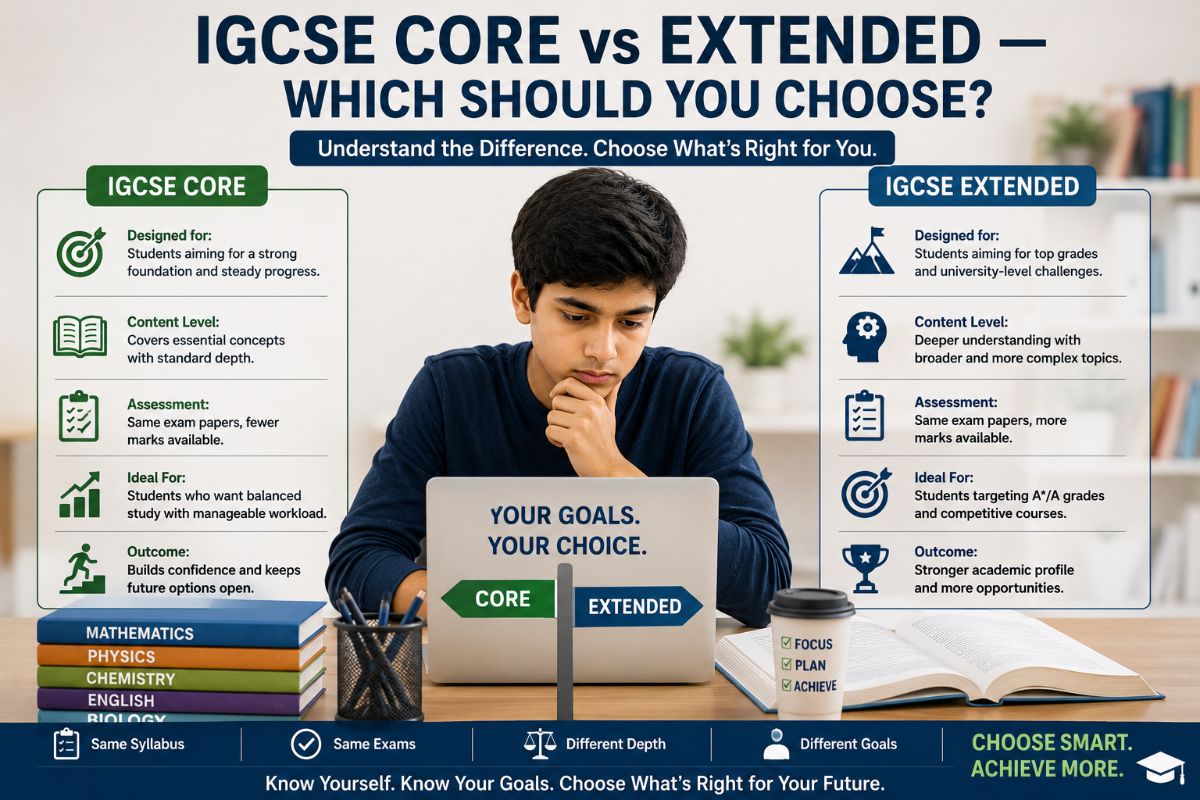
If your child is beginning their IGCSE journey — in Grade 9, or sometimes Grade 8 — one of the first decisions a school asks families to make is: Core or Extended? Many parents agree without fully understanding what the choice means for their child's future.
This guide is a practical walkthrough of what each pathway involves, how they are assessed differently, and how to make the right call for your child.
The Basic Difference
Cambridge IGCSE offers two tiers for most Maths and Sciences subjects:
• Core: Covers the foundation syllabus. Maximum achievable grade is C.
• Extended: Covers the full syllabus, including additional higher-difficulty content. Full grade range available — A* to G.
This single sentence — 'Core students cannot achieve above a C' — is the most important sentence in this entire guide. If a university pathway, scholarship application, or further education track requires a B or above in a subject, Core is simply not an option.
Who Is Core Actually Designed For?
Core is designed for students who are genuinely working at a foundation level in a subject and for whom a C is an appropriate, achievable, and satisfactory outcome. It is NOT designed for:
• Students who 'find Maths hard' but could achieve a B with the right tuition support
• Students whose school has placed them in Core due to administrative ease rather than genuine assessment
• Students with aspirations for any STEM university pathway
The concern at INACADEMICS is that well-meaning schools sometimes place capable but struggling students in Core as a pastoral decision — it reduces their stress and keeps their report card looking reasonable. But it forecloses future options that the student might genuinely have pursued.
The Extended Pathway — What It Demands
Extended covers a wider and deeper syllabus. The additional content in Maths, Physics, and Chemistry at Extended level is not trivially harder — it includes:
• Mathematics: Trigonometry beyond right-angled triangles, vectors, functions, transformations, advanced algebra and probability
• Physics: Electrical quantities at greater depth, nuclear physics, astrophysics (in some syllabuses)
• Chemistry: Organic chemistry fundamentals, thermodynamics, reaction rates
These topics require genuine conceptual understanding and consistent past-paper practice — which is exactly what good Cambridge-trained tuition provides.
The ATP Practical Component
An often-overlooked element of IGCSE Sciences is the Alternative to Practical (ATP) paper. This paper assesses laboratory skills without a physical practical component — students must demonstrate knowledge of experimental design, observation recording, data plotting, and analysis in a written paper. Many students underperform in ATP because they have never been taught to draw graphs to Cambridge's exact specifications or to write observations using precise scientific language.
The 'Switch' Question
Can a student switch from Core to Extended mid-way? In most cases, yes — during the Grade 9 year. By Grade 10, the syllabus gap has usually grown too large. If your child is currently on the Core track and you are unsure whether that is the right place for them, the time to act is now — not in November of Grade 10.
A diagnostic assessment with a Cambridge-trained tutor can tell you within 2–3 sessions whether an Extended track is achievable with structured support.
What Universities Expect
Different universities weigh IGCSE grades differently, but the near-universal standard for any competitive admission is:
• At least B (ideally A or A*) in Maths and Sciences for STEM pathways
• At least C or above across 6–8 subjects
• A* or A in subjects directly related to the intended university course
None of these require Extended — but none of them are achievable on Core. If your child's aspirations involve any competitive pathway, Core is not the right home for their IGCSE Maths or Science results.
INACADEMICS on the Core vs Extended Decision
At INACADEMICS, our Cambridge-trained Sciences teachers work with both Core and Extended students — but our recommendation almost always leans Extended for students who are capable of it with support. We have seen Grade 9 students who entered on Core pathways, moved to Extended with tuition support, and achieved B or A grades in their final Cambridge examinations.
The key is diagnosing capability honestly — not optimistically, and not defeatistically.
Ready to give your child the right guidance? INACADEMICS in Kokapet, Hyderabad has been helping IB MYP, IGCSE, ICSE, and CBSE students achieve their best since 2009. Small batches, certified teachers, and a proven track record — book a free counselling session today.
INACADEMICS · Kokapet, Hyderabad · inacademics.com