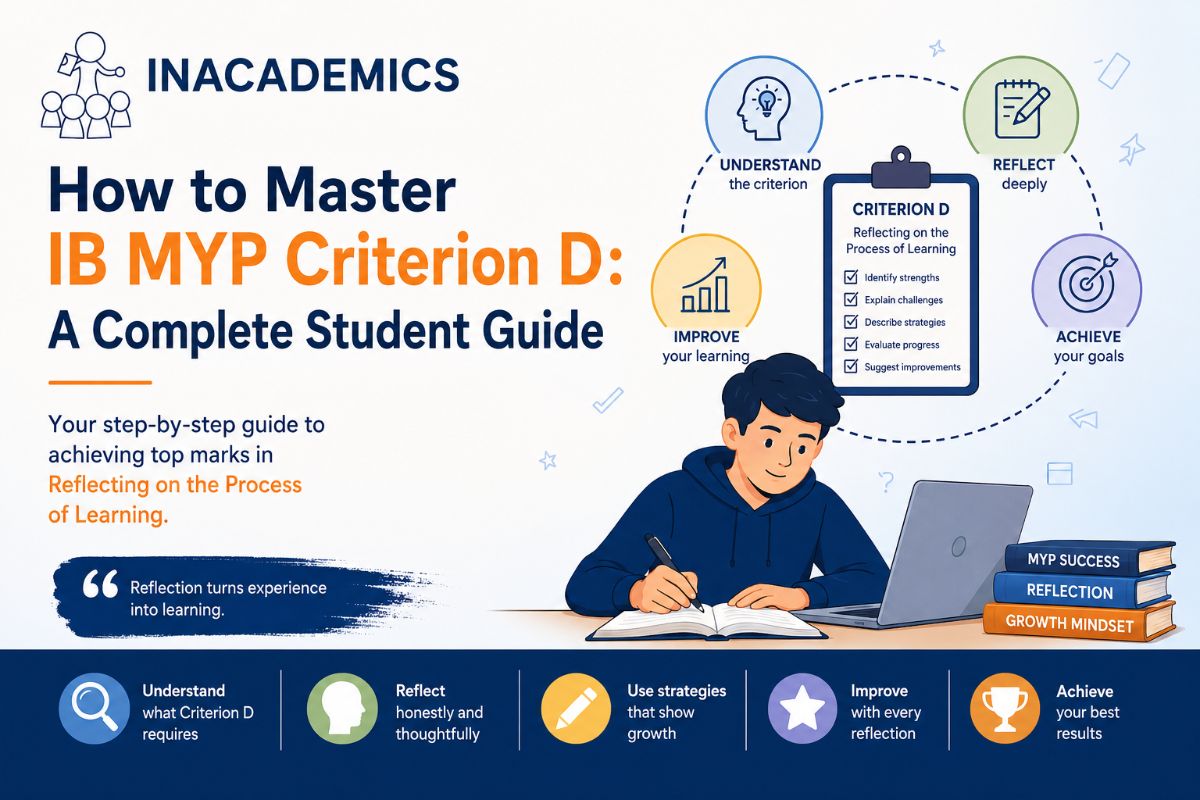
If you are preparing for your IB MYP assessments, understanding Criterion D is one of the most important skills you can develop. Criterion D — also known as Reflecting on the impacts of technology and science, or Reflecting on the design process (depending on your subject group) — asks students to demonstrate genuine reflection, evaluation, and connection-making. Yet it is also one of the most misunderstood criteria. Many students lose marks simply because they do not know exactly what examiners are looking for.
What Is IB MYP Criterion D?
Criterion D sits at the heart of the IB MYP philosophy: the belief that students should not just complete tasks, but critically reflect on what they have done, what they have learned, and how their work connects to the wider world.
Across different MYP subject groups, Criterion D focuses on reflection but the precise wording and strand descriptors vary slightly. In Design, it is called Evaluating. In Science, it involves Reflecting on the impacts of science. In other subjects, it may be titled Thinking Creatively or Applying. Always check your subject-specific MYP guide.
The Four Achievement Levels
MYP Criterion D is scored on a scale of 0–8, divided into four achievement level bands: 1–2, 3–4, 5–6, and 7–8. To achieve a 7–8, students must demonstrate sophisticated, detailed reflection that links their personal experience to broader contexts — social, cultural, ethical, or environmental.
Common Mistakes Students Make
• Summarising what they did instead of reflecting on WHY it worked or did not work
• Making vague claims without specific evidence from their own work
• Failing to connect to real-world impacts or contexts
• Not suggesting meaningful improvements backed by reasoning
• Using generic language instead of subject-specific vocabulary
Your Revision Action Plan
Start by reviewing all past Criterion D questions from the MYP 5 question bank. Practise writing structured responses that follow the three-part formula: evaluate your process → identify limitations → suggest improvements with justification.
💡 Inacademics Tip: Use Inacademic's MYP 5 Criterion D question bank to practise timed reflection responses. Their structured answer templates map directly onto the IB MYP rubric strands, helping you internalise exactly what each achievement level requires.