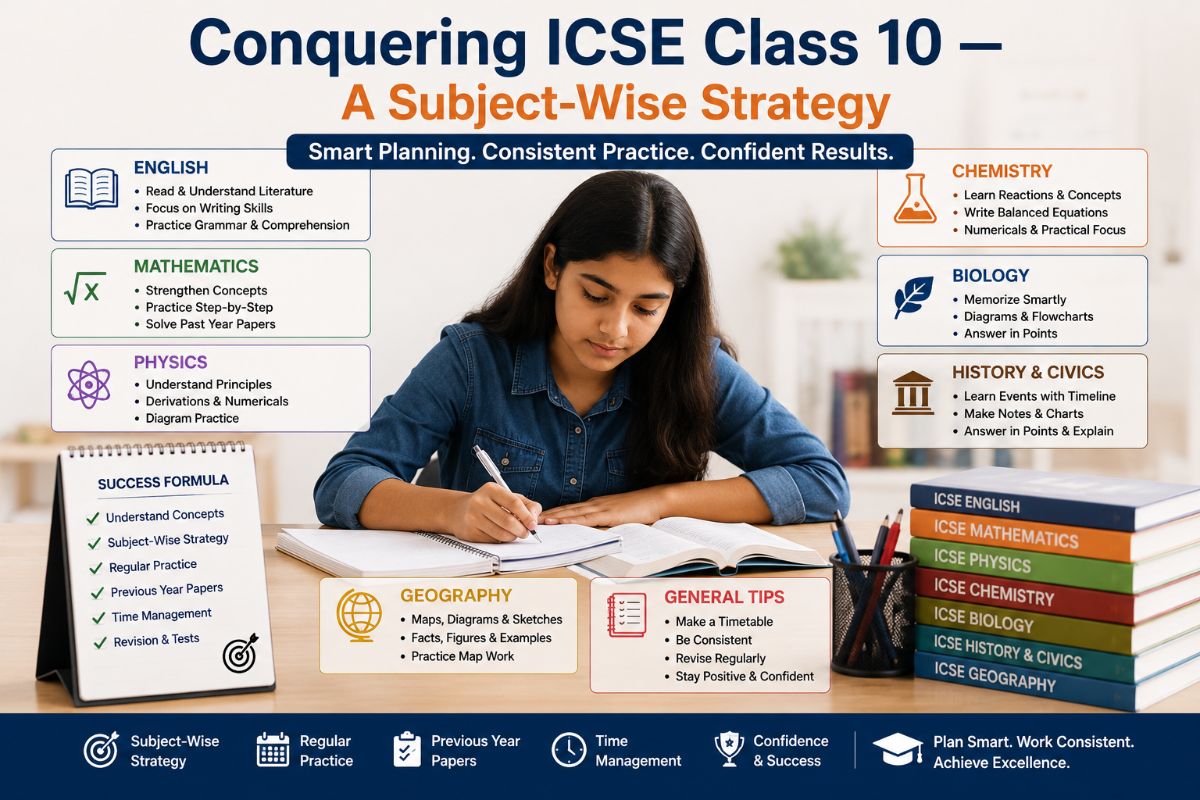
ICSE Class 10 is one of the most demanding board examinations in India — not because of difficulty in isolation, but because of breadth. Eleven or more subjects, each with its own board-specific pattern, its own reference book ecosystem, and its own marking style. Most students who underperform in ICSE do not fail because the content is too hard — they fail because they spread preparation too thin, too late.
This is a subject-by-subject playbook drawn from 25+ years of ICSE board experience at INACADEMICS.
The ICSE Assessment Structure First
ICSE Class 10 boards have a specific assessment architecture that students must understand before they prepare:
• 80% of marks come from the external board examination
• 20% come from internal assessment (school-conducted practicals, projects, and internal examinations)
• The internal assessment is often underestimated — a student who neglects school practicals sacrifices marks that cannot be recovered in the written paper
Internal assessment marks are submitted by the school to CISCE before the board exams begin. By the time a student sits the written paper, 20% of their final score is already determined. Handle it accordingly.
Subject-by-Subject Strategy
Mathematics
ICSE Maths is highly syllabus-specific — questions do not stray far from the standard topics. The core reference is ML Aggarwal, backed by RS Aggarwal for additional practice. The most important preparation strategy is topic prioritisation: Banking and Shares, Probability, Statistics (median, mode, mean, histograms, ogive curves), and Mensuration together account for a disproportionate share of marks every year. Practise these topics relentlessly. The last 10 years of ICSE Maths papers follow predictable question patterns — past paper drilling is the single highest-return activity.
Physics
ICSE Physics is concept-heavy and numerically demanding. Selina is the primary reference. Key topics that appear almost every year: Force and Machines, Light (refraction, lenses), Electricity (circuits, resistance), and Sound (resonance, wave properties). Physics marks are lost in two places: incorrect formula application (students memorise formulas but apply them in the wrong scenario) and incomplete diagram labelling. Draw every diagram with a ruler. Label every component.
Chemistry
ICSE Chemistry has a reputation for unpredictable questions, but the unpredictability is usually in the organic chemistry and Practical Chemistry sections. The predictable scoring areas are: Periodic Properties, Chemical Bonding, Mole Concept, Electrolysis, and Metallurgy. Practical Chemistry questions (identifying gases, describing reactions by observation) require specific, precise language — 'colourless, odourless gas that relights a glowing splint' is the expected answer, not 'a gas that burns'. Precision of language is Chemistry marks.
Biology
ICSE Biology is diagram-intensive. A well-labelled, accurate diagram of the nephron, heart, or plant cell is worth significant marks — and takes 10 minutes to master per diagram. The key studying mistake in Biology is reading the NCERT instead of ICSE-specific resources. ICSE Biology has its own specific content requirements that differ from CBSE — always use the Selina Biology reference for Class 10. Topics with very high mark weightage every year: Excretion, Reproduction, Human Nervous System, and Genetics.
English Language
ICSE English is two papers: Language and Literature. English Language Paper 1 (Letter writing, Notice writing, Essay, and Comprehension) is highly standardised — there are specific format marks for letters and notices that can be banked with very little effort if the formats are learned properly. Essay marks, however, are highly variable and depend on vocabulary range, sentence variety, and argument coherence. A student who writes 350 fluent words will outscore a student who writes 600 clunky words every time.
History and Civics
This is the most time-consuming subject for ICSE Class 10 in terms of content volume. The trick is not to study everything equally — it is to identify the high-frequency topics from the last 8–10 years of question papers and study those deeply. The Civics portion (Indian Constitution, government structure) is almost entirely predictable year to year.
The Revision Calendar That Works
Based on INACADEMICS's 25-year track record with ICSE students, the most effective Class 10 board preparation follows a 4-phase approach:
1. Phase 1 (September–October): Complete syllabus coverage with a focus on understanding, not memorisation. Every concept should be understood, not just read.
2. Phase 2 (November–December): First past-paper cycle. Do the last 5 years of ICSE papers under timed conditions. Mark them honestly. Build an error log.
3. Phase 3 (January–February): Targeted revision based on error log. Focus only on weak areas. Redo past papers specifically in topics where marks were lost.
4. Phase 4 (February–March, last 4 weeks): Full-paper mocks under exam conditions. Four mock papers in total — one per subject block. Speed and format accuracy are the focus here.
The Presentation Marks That Most Students Lose
ICSE examiners award marks for presentation — legibility, neatness of diagrams, use of underlining for headings, proper paragraph breaks, and logical flow. These are not bonus marks — they are built into the marking scheme. A student with the same content knowledge but better presentation will score 3–5% higher. Train for presentation from the beginning of Phase 1, not as a last-minute afterthought.
Ready to give your child the right guidance? INACADEMICS in Kokapet, Hyderabad has been helping IB MYP, IGCSE, ICSE, and CBSE students achieve their best since 2009. Small batches, certified teachers, and a proven track record — book a free counselling session today.
INACADEMICS · Kokapet, Hyderabad · inacademics.com