What Parents and Students in Hyderabad Need to Know
If you have a child in Class 10 this year, you have probably already heard the rumour going around WhatsApp parent groups: "CBSE has changed the exam pattern, the new papers are much harder." The truth is a little different. CBSE has not made the syllabus harder — it has made the questions harder to answer without actually understanding the concept. For a board that used to reward neat handwriting and a well-memorised textbook answer, that is a significant shift, and it is one every Class 10 student in Hyderabad needs to prepare for differently this year.
At INACADEMICS, we have been working through the new CBSE sample papers with our Class 10 batches over the past few months, and this blog breaks down exactly what has changed, why it matters, and how a student should restructure their preparation — with a real example question to show you what we mean.
What Has Actually Changed
CBSE has restructured the Class 10 question paper around what it calls Competency-Based Questions, or CBQs. These now make up 50% of every 80-mark theory paper in Science and Mathematics, with the remaining marks split between objective-type questions (around 20%) and traditional short and long answer questions (around 30%). This is not a one-year experiment — CBSE has confirmed it will continue the same structure for the 2026 board exams, having introduced it for the 2024–25 academic session as part of the National Education Policy 2020 reforms.
A few other changes are worth knowing about for this year specifically:
Two board exam attempts. Starting with the 2025–26 academic year, Class 10 students get a main board exam in February and an optional improvement exam in May, with the better of the two scores counted toward the final result. The February exam is compulsory; the May one is not.
Stricter sectional answer writing. For Science and Social Science papers, CBSE has made it mandatory for students to organise their answer sheets section-wise rather than answering questions in whatever order they like. This sounds like a small administrative detail, but it actually changes how a student needs to plan their time inside the exam hall.
New case-based formats. Several questions in each paper now begin with a short passage, a data table, or a description of an experiment, followed by three or four sub-questions built around that material. In the Science paper, these typically show up as specific numbered questions rather than being scattered randomly through the paper.
None of this changes what is in the NCERT textbook. What it changes is how a student is asked to use that knowledge.
Why This Catches Students Off Guard
The 2025 board exams gave us a useful preview of what happens when students prepare the old way for the new pattern. Teachers reported that a meaningful share of students found the Mathematics paper unexpectedly difficult, not because the topics were unfamiliar, but because there were very few "straightforward" questions left — the kind where you recognise the question type instantly and reproduce a memorised method.
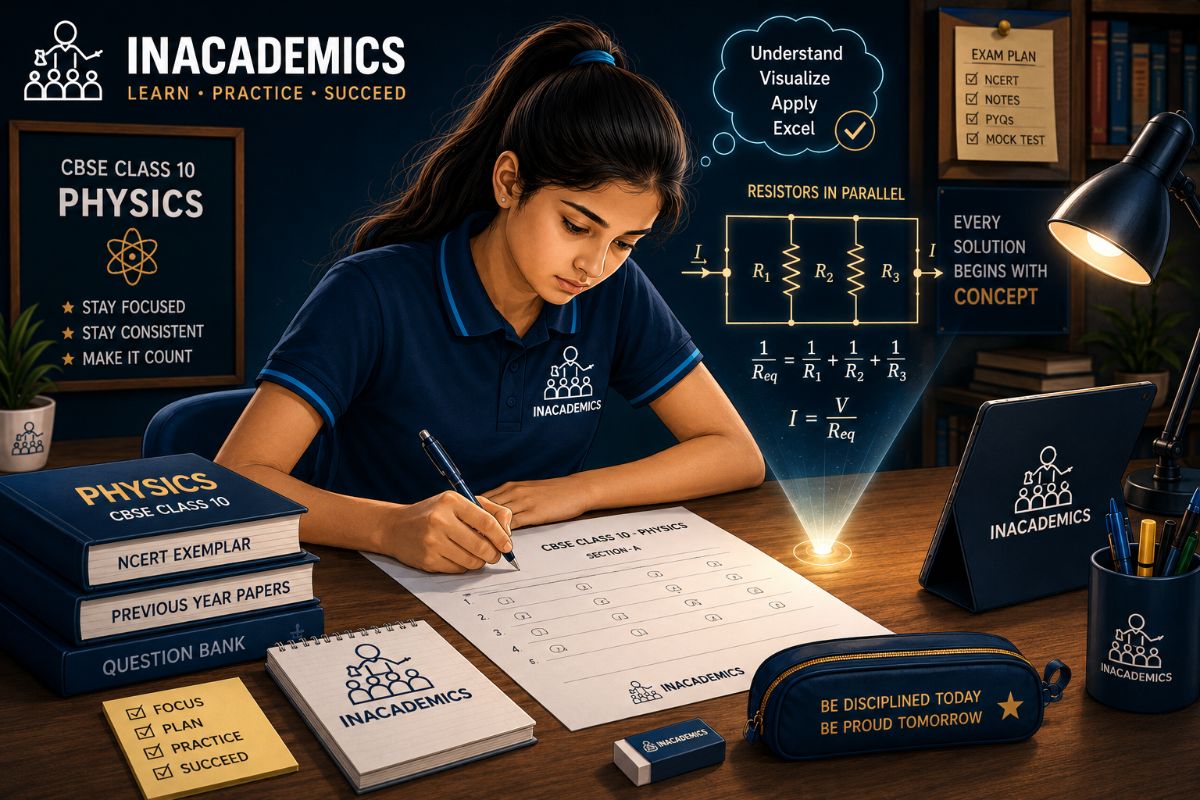
This is the core issue we see in our own batches at INACADEMICS. A student can know the formula for resistors in parallel perfectly, recite it on demand, and still lose marks on a CBQ because the question never says "calculate the equivalent resistance." Instead, it gives you a circuit diagram embedded in a real-world scenario — a string of decorative lights, a faulty home wiring setup, a science fair project — and expects the student to recognise on their own that this is a parallel resistance problem before they even begin solving it. The skill being tested is recognition and application, not recall, and that is a skill students have to build deliberately. It does not show up automatically just because someone has memorised the chapter.
A Worked Example: How a CBQ Actually Plays Out
Let's take a topic every Class 10 Science student knows well — electricity, specifically resistors in parallel — and look at how it would appear as a competency-based question versus the old-style direct question.
The old-style question would simply say:
"Three resistors of 2Ω, 3Ω, and 6Ω are connected in parallel. Calculate the equivalent resistance of the combination."
A student who has memorised the parallel resistance formula can answer this in under a minute without engaging with anything beyond the formula itself.
The competency-based version looks more like this:
A small electronics hobby club at a school wants to set up a string of three LED-based decorative bulbs for a fair. They have three resistors available, with resistances of 2Ω, 3Ω, and 6Ω, and they connect them in parallel across the same two points so that even if one resistor fails, the circuit keeps working for the others.
(a) Calculate the equivalent resistance of the combination. [2 marks] (b) If a fourth identical resistor is added in parallel, would the equivalent resistance increase or decrease? Justify your answer using your result from part (a), without recalculating the exact value. [2 marks] (c) The hobby club initially considered wiring the three resistors in series instead, "to keep the design simple." Explain why this design choice would actually be unsuitable for their stated goal of keeping the circuit working even if one bulb fails. [3 marks]
Notice what has happened here. Part (a) is still a direct calculation, and a student needs the same formula and the same arithmetic as before. But part (b) tests whether the student actually understands the relationship between the number of parallel resistors and the equivalent resistance, rather than just being able to plug numbers into a formula — and it specifically asks them not to recalculate, which blocks students who only know how to compute but not how to reason. Part (c) goes further still, testing whether the student understands why parallel circuits behave the way they do in a practical context, which is a classic Application-and-Analysis level question under Bloom's taxonomy, and the kind of marks that are easiest to lose if a student has only ever practised the bare numerical version of this question.
This is exactly the structure CBSE is now using across Science and Maths: a short context, then sub-questions that climb in difficulty from straightforward recall or calculation toward reasoning and justification. A student who has only practised the bare numerical version of this question — which is how most of last year's Class 9 worked, and how Class 10 students were taught for years before this reform — will get part (a) right and may completely lose parts (b) and (c), even though the underlying physics is identical to what they studied.
How Students Should Actually Prepare
1. Build NCERT understanding first, supplementary practice second. This sounds obvious, but it is worth saying clearly: no CBQ workbook or sample paper compilation is a substitute for genuinely understanding the NCERT chapter. CBQs are built on NCERT concepts; they are just asking a different kind of question about them. Students who try to shortcut straight to practising CBQ-style questions without a solid grip on the underlying concept tend to memorise patterns of answers rather than developing the reasoning the questions are designed to test — and that approach falls apart the moment the scenario in the question is even slightly different from one they've seen before.
2. Practise explaining "why," not just "how." Every time a student solves a numerical problem, they should get into the habit of asking themselves: if I changed one number, or one condition, in this question, what would happen to the answer, and why? This is precisely the skill that parts (b) and (c) in the example above are testing, and it is a habit that needs weeks of repetition to become automatic, not something that can be crammed in the final month.
3. Practise reading and dissecting unfamiliar scenarios. A good chunk of CBQ difficulty is not physics or maths difficulty at all — it is the discomfort of seeing a new, wordy scenario in an exam and not immediately knowing which textbook chapter it belongs to. The fix for this is repeated exposure: working through CBSE's official sample papers (freely available on cbseacademic.nic.in) and a range of case-based questions across chapters until the "find the concept hidden in the story" step becomes quick and confident rather than panic-inducing.
4. Get familiar with the official marking schemes, not just the questions. CBSE's sample paper PDFs come with detailed marking schemes that show exactly how marks are awarded for partial working, common errors, and acceptable variations in phrasing. Students rarely read these closely, but they are one of the best tools available for understanding what an examiner is actually looking for — and for learning how to write answers that capture every mark a correct method deserves, even under exam time pressure.
5. Practise sectional answer writing under timed conditions. With Science and Social Science papers now requiring section-wise answers, students need to physically practise organising their answer sheet this way during mock tests, not discover the requirement for the first time in the exam hall.
How We're Approaching This at INACADEMICS
Our Class 10 batches across IB MYP, CBSE, ICSE, and IGCSE streams are built around small group sizes specifically so that this kind of conceptual, reasoning-based teaching is possible — it's very difficult to build a student's ability to handle an unfamiliar scenario question in a classroom of forty. Our CBSE Science and Maths sessions this year have been restructured to spend meaningfully more time on case-based and application questions, working through scenarios similar to the resistor example above across every major topic, rather than just running through formula-based drilling.
The shift CBSE has made is, ultimately, a good one — it rewards students who understand their subject rather than those who are simply good at memorising. But it does mean preparation has to change too, and the earlier a student adjusts how they study, the less stressful the final months before the boards will feel.
If you'd like to understand how your child's current preparation stacks up against the new pattern, or want a session focused specifically on competency-based question practice, feel free to reach out to us at INACADEMICS in Kokapet.